SE France: Nice, Toulon, Marseille, Nîmes

Day 116 - Nice
The alarm woke me, and I was soon out of the room, down the stairs, and off crossing through Sanremo on my way to the station. As I arrived early, I sat at the far end of the tunnel to wait for the 9:06 train west; unfortunately, a young punk decided the no vaping rules didn’t apply to him, and was ignored by the nearby carabinieri. I made sure we were in different cars as we headed to Ventimiglia to change for the French train.
Having learned the process the day before, hauling the bags wasn’t as big a challenge, knowing where to go. The train to Nice arrived, and folks crowded aboard, leaving me standing near the doors with my stacked luggage. At subsequent stations, those newly boarding were quicker than me, so I stood for the hour it took to get to Nice-Ville.

My lodgings were not too far away, down an incline, under the railroad tracks and half a block of buildings facing the overhead rails. First attempt was at the wrong address, but I eventually found the correct door, entered the code and got my gear inside. Then an elevator up 4 levels and I met the concierge. Gear went into room 2; there were two chairs, a small table and a king bed; I would be sharing the bathroom facilities.
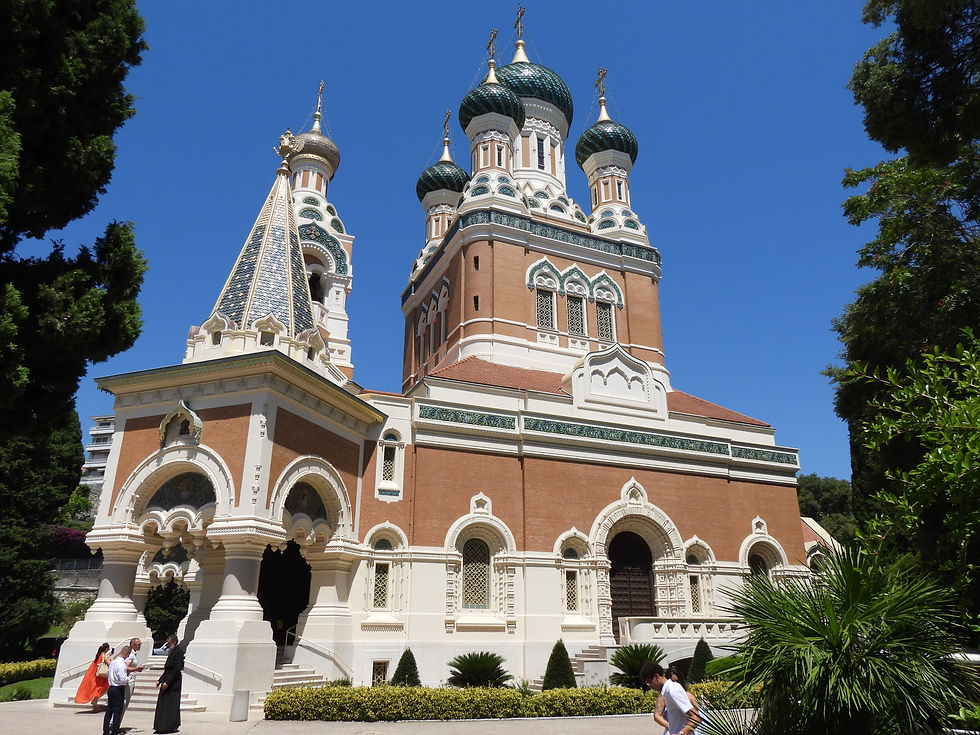
My appliance on the table, my camera and bag on my shoulders, and I was off. With four sites to visit, I’d hoped I’d add three more cathedrals to my list. First off to the orthodox cathedral. On the same (north) side of the tracks, the walk was 1½km. The Nice Cathédrale Orthodoxe Russe Saint-Nicolas is a multi-turreted church with gold-capped “onion” domes, painted in Victorian shades of deep aqua, burnt orange and white with gold features. I arrived at 12:40, and the building would be closing for lunch at 1pm.
There is a cordon at the door from the narthex, which, for 5€, I bypassed to enter the nave for my photographing. Still slightly smoky from the incense used during the morning service, the sunlight beams streamed into the space. For me, it created a gelled look in the pictures. Predominate colors were a Marian blue and gold; the iconostasis was covered in gold-leaf.
View of nave and dome vault in the Orthodox Cathedral in Nice Iconostasis of the Orthodox Cathedral in Nice Shrine with icons inthe Orthodox Cathedral in Nice
Crypt musuem, with video running on the Bolshevik Revolution Cross and icon in the Orthodox Cathedral Musuem in Nice Liturgical vestments in the Orthodox Cathedral Musuem in Nice Ceremonial liturgical crowns in the Orthodox Cathedral Musuem in Nice Icon of St Nicholas in the Orthodox Cathedral Musuem in Nice
Finding it a small space, I soon descended into the crypt/museum/treasury where a video played explaining the history of the Russian diaspora after the 1917 Revolution. Promptly at one I was escorted down the stairs, and I took my outside shots as the building was locked.
Street in the Carre d'Or in Nice, France Corner building in the Carre d'Or in Nice, France Plaza and city building in Nice, France Marble statue of a male, Nice France View of street in Vieux Nice
Crossing under the overhead rails to the west of the station, I followed the route from Maps, taking pictures of buildings, pedestrian streets, and plazas. Reaching the Old Cité, moving through tourists in the narrow streets, I came to the Cathédrale Sainte-Réparate de Nice. Facing eastward into the Place Rossetti, its separated white belltower is to the north. Five stories high, the front façade is divided in half: large main entry doors lower and a rectangular window flanked by statues above. Behind it, along the slate roof, is a large dome with a smaller lantern. It is so tightly placed in the old section of Nice that its footprint is only evident from a high point.
Plazas-level view of Cathédrale Sainte-Réparate de Nice. View of Cathédrale Sainte-Réparate de Nice. from La Colline du Chateau
The nave’s columns are topped with exquisite capitals, ending in the large arch of the crossing. Beyond is the sanctuary, an apse behind a marble altar rail. The side aisles lack pews, but many side chapels offer places for prayers to saints. Included in one was a relic of the True Cross, presented on a cross of lapis, behind protective glass. While the transept arms are not deep, one is devoted to Mary, while that to the south is blocked off by the organ pipes. The shorter apse is heavily decorated in gold, three large paintings on the carved walls. As I continued to explore, I captured many images of the smaller angels which adorned the upper reaches.
View of the sanctuary of Cathédrale Sainte-Réparate in Nice View of interior of the dome at the transept crossing, Cathédrale Sainte-Réparate in Nice Detail of the ceiling vault, Cathédrale Sainte-Réparate de Nice Relic of the True Cross, Cathédrale Sainte-Réparate de Nice Angled view of the nave of Cathédrale Sainte-Réparate de Nice Reliquary of the patron saint, Cathédrale Sainte-Réparate de Nice
Ruins on the Colline du Château hill to the south of the old city were my next goal. Getting there involved climbing streets and stairways up the steep hill overlooking the port city.
View out over Vieux Nice toaawards the Mediterranean Sea Stairway up the Colline du Chateau, Nice Three language signs on the Colline du Chateau, Nice
As I rose above the many roofs of Nice, I could appreciate the beauty of the dome and belltower of the cathedral. The park has signs in French, Italian and English strategically place, identifying elements of the plateau. A surprise for me was the presence of the ruins of the 11th-12th century cathedral dedicated to the Virgin Mary. I circumnavigated the fenced off archeological site, getting my angles.

Ruins of the 11th-12th century Cathedral dedicated to the Virgin Mary, Colline du Chateau, Nice Signage on the Colline du Chateau explaining the cathedral ruins, Nice Signage on the Colline du Chateau explaining the cathedral ruins, Nice Ruins of the 11th-12th century Cathedral dedicated to the Virgin Mary, Colline du Chateau, Nice
It was coming up on 4pm, and I had booked a GetYourGuide walking food tour at 5pm. Unsure of the meeting point, I headed down on a different path, again getting a picture of the St Réparate Cathedral as I descended. Passing the Cimitiere du Chateau de Nice, I came to parallel wide boulevards. Cathédrale Sainte-Réparate de Nice rose up above the trees, and I spent a few minutes visiting the mid-nineteenth century parish church, Église Saint-Jean-Baptiste - Le Vœu de Nice.
Man-made waterfall on my descent from the Colline du Chateau, Nice Cemetery of the Chatau in Nice Exterior, Église Saint-Jean-Baptiste - Le Vœu de Nice. Nave and aspe, Église Saint-Jean-Baptiste - Le Vœu de Nice.
Down the street was the rendezvous point, Le Bistrot de Lou Balico. My guide for the Provencal Food Walking Tour and Tasting, Mathilde, explained the significance of this Nicoise restaurant, plus that it had been a haunt of Jean-Paul Belmondo. The first food was a Nicoise salad in a thick bun, which had been prepared at lunch, since they wouldn’t open until later. With a bottle of water, I ate it while sitting on the edge of a fountain, listening to her talk. On to a patisserie, where I tried a savory, a tidbit made with Swiss chard and apples in a pastry. Next up at Sini&Jiji we tried 3 treats including roasted onion and olives as a pizza and a fried squash blossom.
Meeting point for the walking food tour, Le Bistro de Lou Balico, Nice Nicoise salad on a bum from the Bistro de Lou Balico, Nice Savory tidbit of Swiss chard and apples Storefront of Sini & Jiji, NIce Pizza of roasted onions and olives at Siji & Jiji Fried squash blossom at Siji & Jiji
At the next stop, at Olio Donato, we did an olive oil tasting. Then at Chez Rene Socca, we had a drink of a white vin de Gard with three appetizers based on chickpea flour flat breads. To cap the tour, a visit to Papilla for artisanal gelato (I tried tiramisu) and a raspberry macaron from Angea.
Storefront of Olio Donato, NIce Staff explaining the olive oilve process, Olio Donato, Nice Sampling taste of olive oil, Olio Donato, Nice Retail space at Olio Donato, Nice Chickpae-based appetizer at Chez Rene Socca, Nice Chickpae-based appetizer offerings at Chez Rene Socca, Nice Tour team waiting on their taste of vin de Gard at Chez Rene Socca, Nice Gelato offerings at Papilla, Nice Another gelato concession in Nice Macaron offerings at Angea, Nice Angea storefront in NIce
As the tour broke up, I asked Mathilde for wine bar recommendations. Heading a bit offtrack to return to my room by walking along the waterfront as the sun was setting, Le Cannon was the closest and turned out to be solely a restaurant, quite busy that Thursday evening. I continued to the SNCF train station and dropped into the adjoining Monoprix to stock up on OJ and chocolate bars. Back at the guest house I took a quick shower. The woman in room 1 arrived, keeping herself quite aloof. The WiFi was poor, mobile reception negligible and the phone battery at 7%, so I plugged it in and read until nearly 11 when it was lights out for me. Unfortunately, the woman in room 3 then began an hour-long phone conversation using her street voice. After 30 minutes I texted the concierge to complain about the discourtesy. My neighbor finished by midnight and things got quiet.
The bed was soft, the room had AC (but no TV, which was no loss for me) and the streets were quiet. I actually slept pretty well, once that neighbor went to sleep. Only once, about 5, did I have to use the common bathroom.
[The Cathédrale Sainte-Marie de Cimiez or Cathédrale Notre-Dame du Château / Cimiez Monastery was the third cathedral I expected to visit. It would have been a 3½km trip to the northeast, either an hour walk, half-hour on 2 public transports or Uber/Bolt, had I had the time. In addition, while in Nice I’d hoped to also visit the Basilique Notre-Dame de l’Assomption, a significant church, but not a cathedral. Next visit?]
Day 117 - Toulon
Getting up shortly after 8, none of my neighbors were around. I got cleaned, repacked, and was off to the train station where an announcement told of a 30-minute delay for the 9:25 TER train heading west along the coast. Pulling out my journal, I noted my activities from the day before, which I’d been unable to do in the room as there wasn’t a surface or good enough light.
The train actually left only 20 minutes late, but was fairly full. I hung out for the 2-hour ride with a tour group mostly from the US, but not all native-born: a 33yo male nurse from Columbia who grew up in Miami and now is based in Phoenix, 3 women from Dallas, a (originally Ukrainian) family from Philadelphia, and lastly, a couple from Glasgow.
Getting off the train in Toulon was a major trial. Getting my luggage through the (uncooperative) crowded train raised anxiety, and then, as usual, I headed initially in the wrong direction. However, by noon I was at the Hotel Le Jaures, ensconced in room 1 on the ground floor.
Room 1 at Hotel Le Jaures, Toulon, France Bathroom for Room 1 in Hotel Le Jaures, Toulon, France Building exterior, Toulon, France Large public art installation, Toulon, France Two paintings displayed on a wall, Toulon, France
After cursory unpacking, as only a one-night stay, I headed out to the west less than a kilometer to reach the Cathédrale de Notre-Dame-de-la-Seds. Snuggly embedded in the middle of a block, the front façade faces south with its 36-meter clock tower on the west corner. Built over 6 centuries, Romanesque in external appearance, the Place de Cathédrale is too narrow for me to take a “full frontal” shot.

Inside, artificial lighting is the major source of illumination, as other buildings abut the north-south running sides. Opposite the entry, the west sunlight does come through a circular stained-glass window with an eight-pointed star with Mary, Queen of Heaven surrounded by the Trinity. The Eucharistic altar has a magnificent retable carved in marble with plaster featuring winged angels with God the Father. Next to it is the sanctuary, with a raised altar table at its entry, alongside the cathedra. The walls of the rectangular apse are lined with rich wooden paneling with carved seating at the base.
View of the nave from the sanctuary, Cathédrale de Notre-Dame-de-la-Seds, Toulon Sanctuary and high altar, Cathédrale de Notre-Dame-de-la-Seds, Toulon Rose window in the apse of the Cathédrale de Notre-Dame-de-la-Seds, Toulon Reredos, Eucharistic Altar, Cathédrale de Notre-Dame-de-la-Seds, Toulon Circular stained glass window, Cathédrale de Notre-Dame-de-la-Seds, Toulon Lateral chapel dedicated to St Joseph, Cathédrale de Notre-Dame-de-la-Seds, Toulon Processional statue, St Peter, Cathédrale de Notre-Dame-de-la-Seds, Toulon View through gats of reliquary chapel, Cathédrale de Notre-Dame-de-la-Seds, Toulon Side aisle view of the nave, Cathédrale de Notre-Dame-de-la-Seds, Toulon Relic of the True Cross, Cathédrale de Notre-Dame-de-la-Seds, Toulon Stained glass window, Sacred Heart of Jesus, Cathédrale de Notre-Dame-de-la-Seds, Toulon Organ loft above the entrance, Cathédrale de Notre-Dame-de-la-Seds, Toulon
The murals high on the walls tended to be faded, two sets of 6 depicting the apostles. The Chapel of the Relics is protected by wrought iron fencing, its elaborate gate locked. Fortunately, openings were wide enough to photograph some details. As in Nice, there is a relic of the True Cross, displayed in a gold reliquary cross. Placards in French explained the features of the building, citing its evolving history and construction, including the very brief period when it had been a mosque during a Turkish occupation.
Leaving the cathedral at 1pm, I headed back to the hotel as I had a wine tasting tour pickup at 2. Across the street at Gaudina Burgers, I had a burger with gorgonzola sauce, which came with a nice salad. I skipped the bottom of the bun.
Street decorations, Toulon, France Street front entrance, Gaudina Burgers, Toulon Menu at Gaudina Burgers, Toulon, France Gorgonzola burger and salad, Gaudina Burgers, Toulon, France
Promptly at 2 Roman showed up and we set off to taste Provencal wines. First stop in the Bandol was Chateau de Pibarnon. [I had to laugh at their marketing: Make Rosé Great Again!] After a production tour, I enjoyed their Bandol blush more than their Nuances or white offerings, or the 4 reds.
Cask room, Chateau de Pibaron, Bandol Fermentation and storage, Chateau de Pibaron, Bandol White and rose tasting, Chateau de Pibaron, Bandol Red wine tasting, Chateau de Pibaron, Bandol

At Domaine de l’Olivette, still in the Bandol, a brief field and production tour was followed by a tasting. Of the white, rosé and 2 reds, my preference was the ’23 rosé.
Ivy covered tower, Domaine de l’Olivette, Bandol Field tour, grapevines, Domaine de l’Olivette, Bandol Stainless tank room, Domaine de l’Olivette, Bandol Bottling line, Domaine de l’Olivette, Bandol Regional promotion poster, Bandol, France Retail space at Domaine de l’Olivette, Bandol Four wine tasting, Domaine de l’Olivette, Bandol Then current pricing list, Domaine de l’Olivette, Bandol

An hour later, after examining the grape clusters on the tibouren vines in the vineyard of Clos Cibonne in the Côtes du Provence, we had a brief cellar tour before sampling 4 wines, where I preferred the second label red! Roman had me back by 6 to the hotel, promising me an email with details of my tastings and a price list for shipping to the States. (Which never arrived. My bad for not following up.)
Tibouren grapes at veraison, Clos Cibonne, Côtes du Provence Bladder presses, Clos Cibonne, Côtes du Provence Retail space, Clos Cibonne, Côtes du Provence Retail display, Clos Cibonne, Côtes du Provence Tasting barrel, Clos Cibonne, Côtes du Provence Departing, we passed this ruin on the grounds of Clos Cibonne, Côtes du Provence
A second day with poor lodging WiFi, the mobile coverage within Le Jaures was non-existent. Checking out the room, it was barebones, a queen bed, luggage rack but ample floor space, while the bathroom had a single towel, a shower in the bathtub with no curtain or bathmat. At least there were enough surfaces for my toiletries. It was quiet, and there was AC. I hung out for a bit, and then wandered down to Temple Bar, where I had a chicken burger and fries, with a red amber Goudale Rubis to start. Capping my meal, I had a La Bête, an 8% strong ale. They had a decent offering of beer on tap (pression.) Four young men playing darts proved to be my entertainment.
The serving bar at Temple Bar, Toulon, France Simple meal: chicken burger and fries, Temple Bar, Toulon Draft beer (pression) menu, Temple Bar, Toulon
Day 118 - Marseille
My plan was to catch the 9:21 train onward from Toulon, but I was awake and up early, and on arriving at the station, caught an earlier one into Gare St Charles. The train filled for the first 8-10 stations (it was a local, for an hour and forty minutes), and I rode to the end of the line. Two (French) cyclists with a trailer slowed departing passengers on the platform. I was staying at the Toyoko Inn Marseille Saint Charles, which was down a hill and opposite the station across a broad boulevard. Crossing the boulevard near the station against Maps direction proved to make it more difficult, but I managed the rough sidewalks under construction and two flights of stairs.
Similar to many ibis Hotels I have stayed in, this was a modern, glass-and-chrome place. Too early to get into my room, I left my gear after grabbing my camera and hat. I had three cathedrals on my list, plus the Basilica, probably the city’s most famous landmark. I’d been to the port city in December 2023 as a cruise stop, but had elected on an excursion to Aix rather than explore the port city. Now I could make up for the oversight.
I’d booked a walking tour at 11, however, I thought it was for 1pm. I had enough time to make it, but I was cathedral-focused and headed down towards the port and the cathedral. The route took me through the “Arab market” area, almost a bazaar in atmosphere. Varying the Maps route, I went an extra block on Boulevard des Dames before heading south on Avenue Robert Schumann. Half a kilometer and I had reached my first goal.

The Cathédrale Sainte-Marie-Majeure de Marseille occupies a full large block on the port, very near where most of the ferries pull in. Impressive in its size, horizontal stripes feature on the external walls, while lantern domes rise to provide natural light inside. The largest dome is over the crossing, with three more smaller domes over the transept arms and the apse. Two tall towers capped with yet smaller domes rise on either side of the south-facing entrance. A tall wide arch at the entry acts as a covered open-air narthex.
After moving around the front, shooting from many angles, I entered through the east passage into the side aisle of the nave. The side aisles are narrow, used just for traffic, the flooring a mosaic tiling. In the arms of the transept, statues representing Mary (south) and Joseph (north) are the simple arrangements. The Eucharistic altar is to the side, behind a door in a quiet chapel for prayer; the Stations are on the walls. Under the large dome, a golden altar table is placed in an octagonal mosaic, the high altar behind it under a baldachin in the apse. Based at the columns around the altar are statues representing the four evangelists.
Model of Cathédrale Sainte-Marie-Majeure de Marseille Main entry door into Cathédrale Sainte-Marie-Majeure de Marseille View from the nave to apse of Cathédrale Sainte-Marie-Majeure de Marseille Angled view of the nave of Cathédrale Sainte-Marie-Majeure de Marseille Main altar and sanctuary with balduchin to rear in Cathédrale Sainte-Marie-Majeure de Marseille Detail: crown of the balduchin in the apse of Cathédrale Sainte-Marie-Majeure de Marseille Bishop's throne in the sanctuary of Cathédrale Sainte-Marie-Majeure de Marseille View up into the dome at the crossing of Cathédrale Sainte-Marie-Majeure de Marseille Detail: elaborate mosaic tiling at a side chapel, Cathédrale Sainte-Marie-Majeure de Marseille Transept arm: sytlized angels on walls, Cathédrale Sainte-Marie-Majeure de Marseille Crucifix icon, Cathédrale Sainte-Marie-Majeure de Marseille Stained glass window, Cathédrale Sainte-Marie-Majeure de Marseille
There are galleries over the side aisle walkways, but were not available to tourists. There is however, an ambulatory around the high altar, which is open and interesting. On the ends of the transepts are wall-mounted stylized golden angels, which I found quite striking. Unlike in most western large churches, the organ pipes visible were only the trumpets, although I saw several consoles.

Asking the conseil, I learned that the predecessor cathedral, the Vieille Major, or properly, the Marseille Ancienne Cathédrale Sainte-Marie-Majeure de Marseille was the building to the east. Dwarfed by La Major, the cream-colored stone blocks had been cleaned, and restoration efforts had been taken to repair the building. Part of the peripheral fencing around the cathedral, I was able to walk first inside the enclosure, and then outside to study the ex-cathedral. It will be educating to return once the work in complete and the building open to the public.
Now approaching 1pm, I headed over to the Vieux Port Metro stop for the walking tour. Once there and finding no one, I discovered my mistake and emailed the guide to apologize. He offered a later tour, but I was heading to the third cathedral and wouldn’t be back in time. Checking Maps, it was a nearly straight shot down Rue Paradis, a 3½km walk that would take about an hour.
Street art on the side of a building in Marseille Caisse d'Epargne (bank) building, Marseille Wooden double doors, Banque de France, Marseille Shuttered windows with carvings, Marseille Lintel flourish and carving over door, Marseille
Rue Paradis proved to be an interesting thoroughfare. At times one way, I could have taken the bus to Avenue du Prado and had a much shorter walk. However, that Saturday was beautiful, and I ambled along, window shopping, studying the facades and architecture, seeking as much shade as possible. Nearly two hours later and I was outside the gate surrounding the Cathédrale Apostolique Arménienne des Saints Traducteurs de Marseille.

A woman unlocked the gate to leave, and, when I asked to visit, was given a hard no by the guard. Lovely on the outside in a well-manicured mini-park, I took several more outside shots and headed back rather disappointed.
Architectural features on the exterior of the Armenian Cathedral in Marseille Architectural features on the exterior of the Armenian Cathedral in Marseille Architectural features on the exterior of the Armenian Cathedral in Marseille
Taking the Metro back into the port, I found the carraiges of the frequent trains to be hot. From the port stop, I walked up the hill, through the Moslem sector before reaching the hotel at 3pm. I was checked in, assigned room 604. Collecting my luggage, I rode up the elevator and down a long hall to the room, which paced away from the boulevard out front. Finding a heavy duvet on the bed, I called down to ask for just a sheet; on their first pass, it was a blanket, but on the second, just a duvet cover which was fine.

Pushing the AC to 23°C, which is cool for me, I sat in the room and did Facebook and emails for a couple of hours. At 1715 the 5-hour pub crawl I’d booked for 9pm was canceled. Not happy, I futzed a bit, and then used Maps to suggest a wine bar. After walking past a serious triumphal arch, I entered L’Audacieux, down near the port. I was outside, the street active with cars. Sticking with Provencal wines, the first was a white from Cotes d’Aix, a’23 Chateau Bas. Light in color it was mostly floral tasting, probably a good tiki bar or patio wine. Ten minutes after I sat down, the church across the street began chiming its bells (for 3 minutes!), and soon a caravan of cars passed with a wedding party. Needing some food, I ordered a charcuterie board. It had two cheeses, a slice of peasant paté, and slices of three saucisson, with a small basket of sliced bread.
Moslem district/bazaar in Marseille Storefront for L' Audacieux, a wine cellar in Marseille Bottle of ;23 Chateau Bas, a white from Cotes d'Aix Charcuterie board at L' Audacieux, Marseille Bottles of Boogie-Woogie and a Rasteau at L' Audacieux, Marseille Post sunset view of L' Audacieux, Marseille
Continuing to journal the day’s activities and moving to reds, the next sampling was a fun wine, a ’24 Boogie Woogie, a boire frais from Aubert & Matthieu, who are young male winemakers from Languedoc-Roussillon (Pays d’Oc.) It was followed by a Rasteau, a ’23 from Ogier – a classic Rhone designation. The sun had set, and I was at a table for 4. A trio came in and I offered to share the space. Russian speakers, they kindly switched to English and shared their bottles of rosé. When the woman in the group learned I was 75 and not interested in marrying, she moved on, but I then began speaking with a professional photographer. He gave me his website, but the web didn’t find it.
The walk back up the hill was quieter, most of the street merchants had closed up for the night. The young adult men were respectful as I passed, and I soon was through the doors of Toyoko and heading to my room. I’d heard from daytrip.com, and my driver and I arranged the time for him to collect me in the morning. I never got up the hill to the Basilica opposite the port.
Day 119 – Nîmes I


Rising ahead of the alarm, after looking out my window and seeing the Basilica of Notre-Dame de la Garde and taking a picture, I went to the lobby for the breakfast buffet and had a chocolate pastry and café au lait. After fetching my bags from my room and checking out, Ram pulled up in his Tesla at 9am and loaded my bags before we took off. There were 5 cathedrals on the plan, so we headed out of Marseille for Forcalquier.
Ram has excellent English, is a great conversationalist, and a safe and careful driver. We moved through beautiful countryside, a sunny Sunday morning. A bit more than a hour later we had arrived at the Concathédrale Notre-Dame-du-Bourguet de Forcalquier.

The doors were open, and the lights came on after I had my initial photos. Gothic architecture, initially built in the mid eleventh century as an abbey church, it lacks the spit-and-polish of a big-name cathedral, but its size is larger than a simple parish church. With three aisles, the vault and supporting arches and columns are simple and fairly dark. Ahead in the apse, tall windows fill the sanctuary with light from the southeast.
High altar of the Concathédrale Notre-Dame-du-Bourguet, Forcalquier Nave and pews in the Concathédrale Notre-Dame-du-Bourguet, Forcalquier Eucharistic altar, Concathédrale Notre-Dame-du-Bourguet, Forcalquier Pipe organ under a rose window, Concathédrale Notre-Dame-du-Bourguet, Forcalquier
Obvious changes post-Vatican II, the high altar has been pulled forward, the statues of the 12 Apostles and Christ wrapping the sides. The quire is carved wooden seats filling the wall. Flanking the apse, two chapels: to the left, the Eucharistic altar with a beautiful marble altar table, while seemingly unused with a crucifix on the right. Several side chapels are along the aisle walls, that to St Joseph catching my attention. At the rear wall, composed of dark wood, is a loft with exposed organ pipes and a rose window.
Open-air flea market in the park in Forcalquier Monument in the town square, Forcalquier Open-air flea market in the park in Forcalquier Open-air flea market in the park in Forcalquier
Outside, the street leading from the co-cathedral was filled with an open-air flea market. Tables were loaded with bric-a-brac, and folks were rummaging through looking for treasures. I was back in the Luberon, an area within Provence that I’d visited for 10 days back in 2012, I practically glowed. As we headed to Apt, up on a hilltop was a castle fortification, which we pulled off the road so I could take a picture. Our next destination was deep in the heart of Apt, so it took some maneuvering.

Arriving just after 11, Mass was underway at the Cathédrale Sainte-Anne d'Apt. West-facing with a large oxidized copper dome adjoining the cathedral to its north. A fairly plain façade, the narrow street in front did not lend itself to a great shot. I did slip inside, more brazen than usual, snapping a dozen pictures. The altar and high altar are through a resplendent arch fronting the apse, three large framed oil paintings on the back wall. Moving to the side chapel under the dome, I found the chapel containing the reliquary.
Nave during Sunday Mass, Cathédrale Sainte-Anne d'Apt Sanctuary and altar, Cathédrale Sainte-Anne d'Apt Reliquary Chapel, Cathédrale Sainte-Anne d'Apt View of the rear exterior, Cathédrale Sainte-Anne d'Apt Detail, Ste Anne statue atop dome, Cathédrale Sainte-Anne d'Apt Bronze model of amphitheater in Apt, France
Walking to the Place Carnot, a backward look allowed better appreciation for the size of the dome. In the plaza, a bronze markup displayed the original Roman amphitheater in Apt. Back in the car, as we drove on towards Carpentras, I recalled the various roads I’d been on during my time at Chez Uloi. About an hour later, we were driving on the small streets of Carpentras.

After finding a nearby parking spot, I wended my way, approaching the ex-Cathédrale Saint-Siffrein de Carpentras from the east, the buttresses for the apse radiating out like beams. With a long nave and close buildings, I recognized that probably the better shot would be in front, from the Place Charles de Gaulle. The spire is on the southwest corner, the south side entry framed in late French Gothic style. Getting to the plaza, a more Romanesque main entry. The building was closed, but I had fun taking pictures of the gargoyles on the south entry façade and the steeple.
South facade, Cathédrale Saint-Siffrein de Carpentras Detail, gargoyle, Cathédrale Saint-Siffrein de Carpentras Bell tower detail, Cathédrale Saint-Siffrein de Carpentras Gargoyles, Cathédrale Saint-Siffrein de Carpentras Over entry ornamentation, Cathédrale Saint-Siffrein de Carpentras
Ram had parked by the Mont Ventoux Park, which was filled with campers and vans in another swap meet. He reported he’d found a few trinkets he’d be taking home.
Public art on building wall, Carpentras Small church entrance, Carpentras Car park with ongoing swap meet, Carpentras
Our next destination was the city of Orange. Another hour drive, we continued our northwest travels, now putting us north of Avignon and closer to the Rhone River. The Tesla was hungry, so we stopped in a shopping mall to plug it in, and took advantage of the break to use the facilities of a taco place, and get a large order of pommes frites with what they called a chimichanga: a taco with kebab sauce on the side!

Charged, we proceeded into Orange. I would guess it once occupied a large block, but the entry is now crowded with buildings on either side The Cathédrale Notre-Dame-de-Nazareth d'Orange Is a large long building with a belltower at the back (east). Inside, the barrel vault is brightly lit by clerestory windows, indirect lighting illuminates the murals, paintings and stenciling in the side arches. An iron altar rail closes off the sanctuary, a simple altar table in front of the more elaborate marble high altar topped by a small baldachin. The floors held some magnificent tiled mosaics. Once I left, I did walk around the block to check out the south and east facades.
Nave view towards apse, Cathédrale Notre-Dame-de-Nazareth d'Orange Sanctuary, Cathédrale Notre-Dame-de-Nazareth d'Orange Nave view from altar rail to entry, Cathédrale Notre-Dame-de-Nazareth d'Orange Exterior, east facade, Cathédrale Notre-Dame-de-Nazareth d'Orange Exterior, south facade, Cathédrale Notre-Dame-de-Nazareth d'Orange
Leaving Orange, we headed to the fifth cathedral in Uzès. A change in direction, now heading southwest along our path to the eventual destination of Nîmes. In Remoulins we diverted to pass close to Pont du Gard and then northwest again to Uzès. Unlike the previous 4 visited churches, Cathédrale Saint-Théodorit d'Uzès is southeast of the center city, with broad expanses and ample parking giving access to the Parc du Duché.

Tall and somewhat narrow, the façade is late Gothic, and over the south transept rises a bell tower very reminiscent of the tower in Pisa. Entering, the center aisle nave has a cross vault, two galleries over the side aisle with effective lighting. One side aisle ends in a lovely lapis blue ceiling cross vault over an altar to the Mother and Child; the opposite to St Joseph with the Child, again a blue vault. The apse has a raised high altar, a painting of the Decent from the Cross on the wall behind it. A modern altar and a boxy blond cathedra sit forward.
Nave vault, view looking to entry, Cathédrale Saint-Théodorit d'Uzès Side view of galleries in nave, Cathédrale Saint-Théodorit d'Uzès Sanctuary and main altars, Cathédrale Saint-Théodorit d'Uzès Vault in the Marian chapel, Cathédrale Saint-Théodorit d'Uzès Grand pipe organ, Cathédrale Saint-Théodorit d'Uzès Coffin of St Firmin, Cathédrale Saint-Théodorit d'Uzès Painting depicting St Firmin, Cathédrale Saint-Théodorit d'Uzès
In a chapel, the remains of the mid-sixth century bishop, St Firmin d’Uzès are displayed in a glass coffin. Unfortunately, the stone staircases with iron handrails were locked, preventing me from climbing into the galleries. Over the entry at the rear of the nave, the organ pipes are exposed, the articulating doors spread wide.
When I got outside, the row of mature trees along the south side prevented me from a good shot of the tower, which didn’t lean. Returning to the route to Nîmes, Ram insisted that we stop and that I go visit the Pont du Gard. An aqueduct built by the Romans in the first century of the Christian Era, three levels of arches over the River Gardon brought water over 50km to what is now the city of Nîmes.
We parked in the car park, and Ram sent me on my way, as I hiked along a level path around a bend to marvel over this engineering marvel. Coming around a bend along the river, I was in awe at the immensity. While one can walk the lowest level, during World War II, jeeps would drive across the top. In the river, kayaks and swimmers enjoyed the late July afternoon sun. I got to about half way and then returned to the car. I was so pleased to have finally made it to the Pont du Gard.
Distance view of the double aqueduct - Pont du Gard - over the River Gardon View approaching the aqueduct - Pont du Gard - over the River Gardon Relaxing Sunday afternoon along the Rive Gardon at the Pont du Gard Lower walkway view of the Roman aqueduct - Pont du Gard - over the River Gardon
Three quarters of an hour later, I’d been dropped off, completed the Hôtel Kyriad Nîmes Centre registration and was in room 24. Small, with little floor space, similar tight bathroom, I’d make do for the 2 nights.

The local cathedral would close at 6, so I hustled the 350m and got there by 5:30. Going immediately inside, the white stone of the nave columns and arch vault had a calming feel. The Basilique-Cathédrale Notre-Dame-et-Saint-Castor de Nîmes is a substantial building, with a long nave and, albeit after a brief transept, a long apse. The side aisles under the gallery were small chapels, each with an altar and a painting of its patron. An ambulatory provides a path behind the high altar and the altar table, with several chapels behind locked wrought iron grills. The stained-glass windows mostly featured a single saint, appearing to be about a hundred years old. I was the last out the door as the cathedral closed for the Sunday evening.
Inside view of the nave vault in the Nîmes Cathedral Altar in a side chapel in the Nîmes Cathedral View from sanctuary of side aisle and gallery in the Nîmes Cathedral Main and high altars in the sanctuary in the Nîmes Cathedral Chapel and gating in the ambulatory of the Nîmes Cathedral View of the vault in the apse of the Nîmes Cathedral
Once outside, the restoration fever struck – the entire front façade was covered save the belltower on the northwest corner. Corrugated sheet metal at the street level, and then panels of canvas covered the scaffolding. Fortunately, there were placards with information and illustrations to aid. On my way back I encountered a traffic guard with the Nîmes crocodile in brass, reminding me of the tale told in Avignon. The twin towers of l’Église St Baudile drew my attention, and so I made a visit. A tall Gothic parish church, a single-entry door is up a short set of stairs. The white stone of the region was used for the columns, sides and vault. Finishing with a few prayers, this 20-minute diversion was calming.
Posting on the restoration wal: drawing and floor layout, Nîmes Cathedral Traffic guard crocodile with the symbol for Nîmes Interesting building frontage in Nîmes Bedroom in Hotel Kyriad Nîmes Centre Batroom in Hotel Kyriad Nîmes Centre Exterior facade of l’Église St Baudile in Nimes Splendid stained glass window in l’Église St Baudile in Nimes Lovely rose window in l’Église St Baudile in Nimes O'Flaherty's Irish Pub in Nimes - outside patio Fish and ships, pint of ale at O'Flaherty's in Nimes
O’Flaherty’s was halfway back to the hotel, so I popped in for supper after returning to the room to leave the Nikon and grab the journal. No notes on the meal, but it looks like a dark pression (draft) with fish and chips, appropriate to an Irish pub. Unfortunately, I’d asked for extra crispy frites, and they double fried the fish instead. Back to the room, I backed up the Nikon and the phone, set an alarm and read for a bit.
Day 120 – Nîmes II
Although I was up before the alarm and out the door in 15 minutes, after reaching the train station in Nîmes, I had 20 minutes before boarding the train for Arles. However, the sign flipped and said there was a 45-minute delay which would blow my connection in Avignon. Options that morning were bad, so I checked the trains to Alès. Bingo, I could head north and then return to head southeast in the afternoon.

Thirty minutes to Alès and a 15-minute walk had me approaching the Cathédrale Saint-Jean-Baptiste d'Alès from the back on the north side. Very blockish architectural, the tower over the entry ended with a flat roof with a small metal cone topped by a cross. The only structure in a large tree-filled block to the west of Alès Centre, the fortress-like gray stone church has a single door entry. A funeral was due to start in 10 minutes of my arrival, so I had to move quickly.
Going inside, the central nave was wide, with a ribbed vault in lapis lazuli blue with gold stars; the side aisle topped with deep tall galleries. A white marble high altar is 5 steps up from the sanctuary floor, where a simple altar stands, a thin white slab over a block of hazy green glass. Behind in the apse, a clear marble floor with two rings of dark wooden seats on either side of a small choir organ. The half dome is painted in segments of Wedgewood blue, cocoa and gold. That color palette carries out into the vault of the crossing.
View of the nave and sanctuary, St John the Baptist Cathedral, Alès View of the south aisle and gallery, St John the Baptist Cathedral, Alès Nave and vault looking to entry, St John the Baptist Cathedral, Alès Main altar (lower right) and high altar, St John the Baptist Cathedral, Alès View from north side aisle into nave, St John the Baptist Cathedral, Alès Archbishop's symbol and seal, St John the Baptist Cathedral, Alès
Along the side aisle walls are chapels, while those in transepts are monumental oil paintings. Three years of restoration of the interior five years ago left a stunning worship space. The site has a long history, initiating in the 8th century, it was destroyed in the latter half of the 16th century during the French Wars of Religion, bur rebuilding started in 1633, with the building becoming a cathedral in 1694.
The building, while somewhat isolated, still had a short forecourt, as well as multiple mature trees hugging the outsides. My shots depict the front portion, but don’t allow for a good representation in my book – maybe a winter visit when the leaves have fallen? I left the plaza and walked through town, taking a stroll through the Halles de l’Abbaye, the shopping mall / market.
Entrance (exterior) Halles de l’Abbaye in Alès View inside the market of Halles de l’Abbaye in Alès Cheesemonger in Halles de l’Abbaye in Alès Deli counter at Halles de l’Abbaye in Alès Poissoniere at Halles de l’Abbaye in Alès
With the first of two trains leaving at 12:30, I was able to stroll calmly through Alès. The local train would bring me to Nîmes, and 20 minutes to change to a Intercity train to Arles. I arrived just before 2.

After a 15-minute walk from the station, I arrived in Place de la Republique, a large broad square where the Basilique-Cathédrale Saint-Trophime d'Arles faced out in the northeast corner. I had been trailing a pair of 35-40yo men from the States who were rushing to their B&B – just before the plaza, they abruptly stopped to take a call from their host with instruction. A primatial church, the front façade belies the historic importance of a bishop who is a primate. The Gothic entry, with lions at the base of short columns supporting a portico, fronts onto a plain cream stone block front which barely rises taller than the neighboring building. From the northwest corner I could see just a bit of the tall square belltower.

Three aisles, all rising to barrel vaults 4-stores above the nave floor. Large tapestries and paintings filled the side walls between chapel insets. In the presbytery, the space for a painting over the high altar was bare, suggesting conservation. In a large chapel at the back of the ambulatory, a familiar depiction of the deposition of Christ’s post-crucifixion body in the tomb is backed by red and blue stained-glass windows. Water damage is evident on many of the walls, so I hoped that this church would get government money for restoration soon.
Bas-relief carving over the entry, Cathédrale Saint-Trophime One of several tapestries hanging onthe walls of Cathédrale Saint-Trophime My favorite French Saint, the pilgrim St Roche with his dog Traditional carved depiction of the emtombment of Christ Reliquary in the ambulatory of Cathédrale Saint-Trophime A view across the transepft in Cathédrale Saint-Trophime Side view of the main altar in the sanctuary of Cathédrale Saint-Trophime High altar and sanctuary of Cathédrale Saint-Trophime
The narrowness of the nave, especially the side aisles, belies the volume the footprint sweeps out. At the crossing, the floor widens to a sanctuary with a substantial ambulatory. I came upon two placards which included a floor plan of the Romanesque style cathedral, the other giving the details of the entry portal. Fortunately, I have decent reading comprehension in French.
Out into the bright sunshine in Republique, the obélisque pointed skyward, a few tourists moving about at 3:30pm. The Narbonne-bound through train back to Nîmes would leave at 5:18, so I had nearly two hours to explore the town of Vincent Van Gogh. A park displayed large reproductions of other artists’ work, and I found remnants of the old city fortifications.
Obelisk in Place de la Republic, Arles Artist work on display in an Arles park Old fortifications in the city of Arles Cast iron lantern, Arles Fortification walls in Arles
Getting to the station early, I headed across the street for a Suze, my favorite drink while in the south of France. The train back was quick, and I had a seat to myself, as did the young Frenchman across – albeit two French women came through puffing their displeasure at not finding a seat together.
Exiting the Nîmes station, I headed to the Arena. There had been a music concert there Sunday evening, and I was curious to see if I could venture inside. Tourist access had ended, and ticketholders were queuing up for that evening’s concert by Santana, one in a series of concerts offered by the Festival de Nîmes. After getting some outside shots, I headed back to the hotel to drop the camera, charge the reader, and splash my face.
Train carriage on the return from Arles to Nîmes A view across a plaza of the city of Nîmes A view of the Arena in Nîmes Detail of the outside walls of the Arena in Nîmes View through the passages into the interior of the Areana in Nîmes Modern sculpture of the Nîmes bull
Grabbing my journal, I had Google Maps find me an open wine café, and headed to Maison Burlon. A bit further than the pub from Sunday evening, I sat on a broad open sidewalk. My back to the wall and distant from the smoking patrons, I started with a local “bio” marsanne-grenache blanc blend, ’22 Pura Vida. Encouraged by the owner-waiter, I tried seiches en persillade. The cuttlefish were chewy, with a texture I didn’t really enjoy.
marsanne-grenache blanc blend, ’22 Pura Vida Street patio of Maison Burlon in Nîmes Seiches en persillade at Maison Burlon, Nîmes Tapas menu board at Maison Burlon, Nîmes '23 Terre Astrale, Domaine de l’Eglisette Jambon bellota at Maison Burlon, Nîmes Tataki de boeuf at Maison Burlon, Nîmes ’23 le Pied de Gargantua from Domaine la Coste du Puy
When I had the second wine, a red from Terre Astrale, Domaine de l’Eglisette, the ’23 blend of syrah, grenache (noir) and cinsault, a piece of slate with jambon bellota was much closer to my taste. A second slate platter with tataki de boeuf brought me more protein, which he paired with a Lirac, a ’23 le Pied de Gargantua from Domaine la Coste du Puy. This was a GSM, my current favorite red blend, so I was in seventh heaven. I expected to hear the start of the concert, but I must have been too distant, or the Festival had figured out how to manage the sound.

You can purchase your own copy
(or have me send it as a gift) of
Cathedrals to the Glory of God
by clicking this link:
Volume II has been released

You can order your personal copy
(Print on Demand)
Cathedrals to the Glory of God
Volume II
by clicking this link:


Comments