Italy: Liguria Region and Monaco

Day 112 Genoa
The alarm went off in my room at the Alessandria hotel at 8:15, and I was out heading to the station at 8:50, getting there in half an hour. The lifts weren’t working, so I had to schlep them down and up the stairs individually. There are multiple stations in Genova, so I was pleased the train took me to the main one, which was a brief 5-minute walk from the Piazza Principe station. Too early, the room wasn’t ready, so I grabbed the umbrella, parka, hat and Nikon. The rain had started as I left Alessandria.
Hoping the weather would improve while I was away from Genoa, I returned to the station and caught the 11:43 train west along the coast, getting off 20 minutes later in Savona. Maps said the cathedral would close at 12:45, but I headed across the southern bridge across the Letimbro with an estimate of 18 minutes. As it had been raining recently, the river was brown and filled the course to the riverbank. Not quite raining while I walked, still the street, mostly pedestrian, were empty as I walked past storefronts.
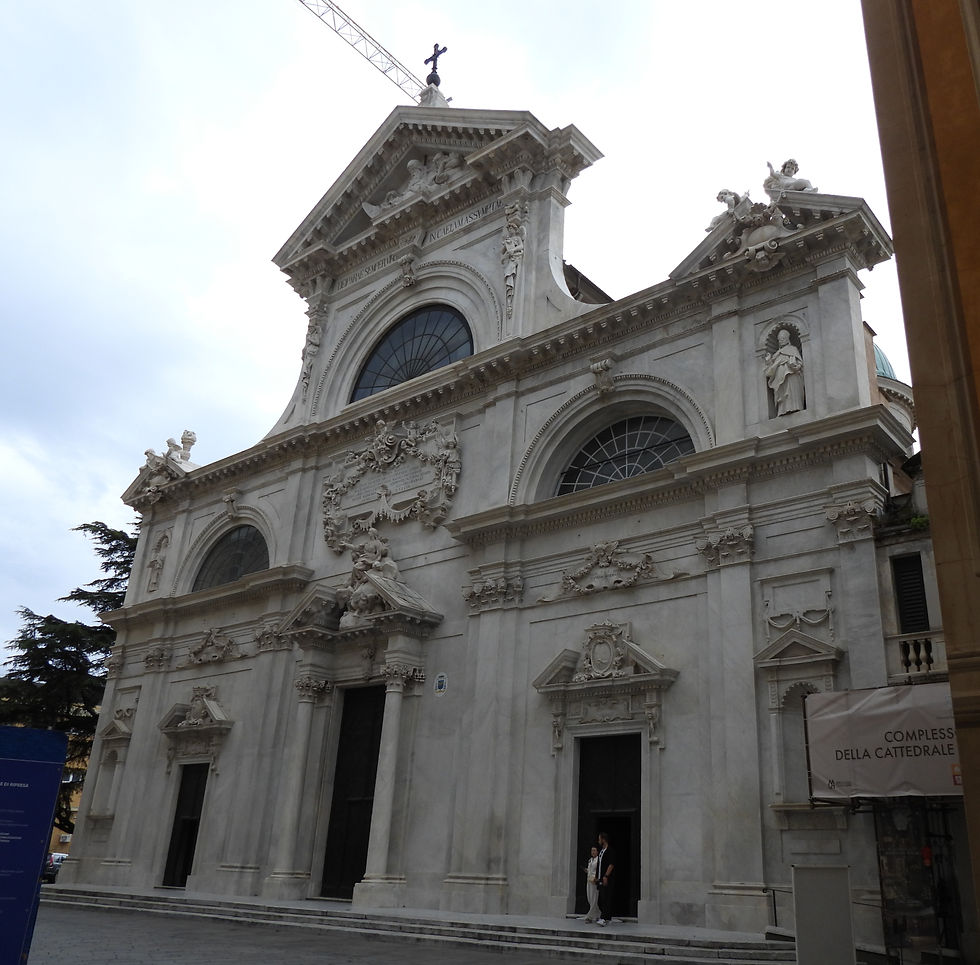
The Basilica Cattedrale di Nostra Signora Assunta / Cathedral Basilica of Our Lady of the Assumption was open, and remained so until at least 2pm when I left. Concerned it might close, I immediately entered from the east-facing doors, finding a long wide nave with tall square columns covered in dun brown stenciling. A lantern over the crossing provided daylight into the center of the cathedral, augmented by lighting from the high vault. I think the width of the transept was greater than the length of the entry to the crossing, and the presbytery arm is equal to one of the transepts: this is a large building.
Nave towards mani altar, Cathedral Basilica of the Assumption of Our Lady in Savona High altar in the Cathedral Basilica of the Assumption of Our Lady in Savona Transept dome and vault in the Cathedral Basilica of the Assumption of Our Lady in Savona Image of the Virgin and Child Choir stalls in the Cathedral Basilica of the Assumption of Our Lady in Savona Mural in the vault of the Cathedral Basilica of the Assumption of Our Lady in Savona Baptismal font in the Cathedral Basilica of the Assumption of Our Lady in Savona Crucifix in the Cathedral Basilica of the Assumption of Our Lady in Savona
Large framed oil paintings are mounted on the side walls depicting scenes from the life of Christ, with frescoes in panels in the ornate ceiling. In the quire, the choir stalls are carved dark wood, with inlay panels for the seat’s backing, filling the curved wall behind the high altar. The white, rose and gray marble floor tiles are set in a geometric pattern in the nave, while forming a multi-bladed fan in front of the altar table.
Exiting after 40 minutes, the sky was lightening and I was able to study the exterior. Renaissance façade of the 16th century, a blockish campanile stands in the southwest corner. Heading back to the station, I elected to walk to the northern bridge, via a route that zigzagged through the central business district to the park Piazza del Popolo, where food trucks lined the streets. Receiving a sample of pulled pork, I purchased a bottle of beer and consumed as I walked through the park. While crossing the river, I noted a structure, quite modern architecturally, which turned out to be a courthouse.
Piazza del Popolo in Savona, Italy Food vendor in the Piazza del Popolo, Savona Courthouse in Savona, Italy Bridge in Savona over the Letimbro River
Subway station Principe in Genoa. Italy Escalator out of the De Ferrari subway station, Genoa, Italy Genoa street approaching the Cathedral
The train brought me back to the main Genoa train station, and by foot the kilometer and a half would take about half an hour, but one stop on the city subway was 10 minutes. So, after getting a pass good for 2 hours, I rode to the De Ferrari stop and had a 5-minute walk.

The Cattedrale di San Lorenzo / Cathedral of St. Lawrence orients so the entry faces northwest, and the axis from entry to apse is even longer than Savona, although there are shorter transept arms. A single campanile rises at the entrance on the southwest corner; three doorways set back with striped arches prove some protection from the elements. The Piazza San Lorenzo provides a large open space in front of the doors, with some café umbrellas over tables and chairs as sitting space.
Mounting the stair to the doorway, I entered into the right-side aisle. The black-and-white striping of the lower façade is carried inside to the spandrels at the tops of the arches lining the nave. Chairs for worshipers fill the interior side of the side aisles, while traditional wooden pews are in the central nave. A cordon ropes off the front of the nave and access to the sanctuary, the apse bathed in a soft golden light highlighting the stain-glass windows above the wooden choir. The walls have sculpted bas-relief carvings, old frescoes and framed paintings, ranging up to the vaults. I found the building to be quite spectacular, gold leaf trimming the murals in the vault, everything clean and polished. The sacramental altar was the least impressive of the chapels. I loved how, at the end of the transept arms, the organ pipes were exposed in cabinets, their doors holding large paintings.
Lion statue on steps into Genoa Cathedral Columns in the nave of the Genoa Cathedral View of the south transept in the Genoa Cathedral Octagonal lantern dome in the Genoa Cathedral Stained Glass windows in the apse of the Genoa Catheral Elaborate murals on the vault of the Genoa Cathedral Rose window over the entry at the Cattedrale di San Lorenzo / Cathedral of St. Lawrence in Genoa Ita Chapel and shrine in the Genoa Cathedral Crossing lantern dome at fhe Cattedrale di San Lorenzo / Cathedral of St. Lawrence in Genoa, Italy View of central nave towards apse from balcony of the Genoa Cathedral View of the transept lantern on the roof of the Genoa Cathedral View of the belltower from the roof of the Genoa Cathedral
Opting to climb the belltower, our group passed through the loft over the entry doors, affording a superb shot down the center aisle and an up-close view of the rose window. Looking out at the roofline, the dome was much more visible. The tour included visiting the gallery: the balcony above the side aisles. Elated, I exited the cathedral and decided to walk the kilometer and a half back to the hotel. Passing multiple churches, I visited three: San Pietro in Banchi, the ex-cathedral Basilica di San Siro / Basilica of St. Syrus, and Basilica della Santissima Annunziata del Vastato. All three were stunning, filled with monumental religious art. I was unaware until I got home that San Siro had been the city’s cathedral from the 4th to the 10th centuries.
Front facade, San Pietro in Banchi, Genoa, Italy Apse vault of San Pietro in Banchi, Genoa Italy High altar, San Pietro in Banchi, Genoa, Italy Sanctuary and apse, Basilica di San Siro, Genoa, Italy View of Nave, Basilica di San Siro, Genoa, Italy Entry signage, Basilica di San Siro, Genoa, Italy Nave view towards entry, Basilica della Santissima Annunziata del Vastato, Genoa, Dome and lantern, transept of Basilica della Santissima Annunziata del Vastato, Genoa, Italy Nave view, Basilica della Santissima Annunziata del Vastato, Genoa, Italy
By 6:30pm I was back to the Hotel Chopin, and the new receptionist Maurizio assigned room 15. Up a flight and a half of stairs, the room had a good size bed, a decent bath, and the window looked out onto a back alley, which should mean it would be quiet. I needed a shower and clean shirt, so I opened the luggage and proceeded. Grabbing my journal, I got two recommendations for enoteca. Opting for the slightly closer one, I hiked the slight rise for 20 minutes to Taggiou Genova.
Red wines offerd at Taggiou Genova, Genoa, Italy Bar space, Taggiou Genova, Genoa Charcuterie board, Taggiou Genova, Genoa Front counter, Taggiou Genova, Genoa My wine samples, Taggiou Genova, Genoa Peaceful walk back to inn, Genoa
A small plates restaurant and wine bar, I got a charcuterie board and some focaccia, and began tasting wines. The resto wasn’t busy, so I enjoyed the conversation as I tried four local reds. After nearly 2 hours, I headed out onto nearly deserted, well-lit streets, walking as taxis were non-existent. Back at the hotel, I organized my gear, read for a bit, and crashed.
Several shots from the streets of Genoa:
View of a stairway in an alley in Genoa Entry to an alley in Genoa Church entry, Genoa Statue outside church, Genoa
Day 113 Albenga
The alarm rang at 8:30, and I was out of the hotel by 9 and off to the station. The 9:43 train was crowded, most every seat taken, which I should have figured: it was Monday, and a national holiday in France, which was less than 200km away. I found an open pair, stuffing both bags into the window seat plus two sacks from a pair of Irish boys, and rode uncomfortably until Albenga.
At the Albenga station, the platform led out to the street, so no stairs and subways to maneuver. The Archivolto del Teatro was a straight shot away from the train, a ten-minute walk, shaded by trees, filled with storefronts and a small park. At the B&B, I was up a flight of steps to a space with 3 bedrooms, the common space and kitchen shared. I had a large bed, plenty of space, and a huge bathroom. Leaving my bags, I returned to the station with my slicker, umbrella and camera, catching the 11:43 to Imperia.
My research left notes that the cathedral would be distant from the station, and a 6-minute taxi would be suggested. Over 3km, an hour walk, I opted for the 8€ ride. Down to the port of Maurizio-Imperia, the western façade of the Basilica Concattedrale di San Maurizio e Compagni Martiri / Co-Cathedral Basilica of St. Mauritius and Companions faces out onto a large piazza, used as a car park. With twin towers bracing the front, the one to the north holds the bells. A palladium porch, supported by six white columns offered protection from the elements.
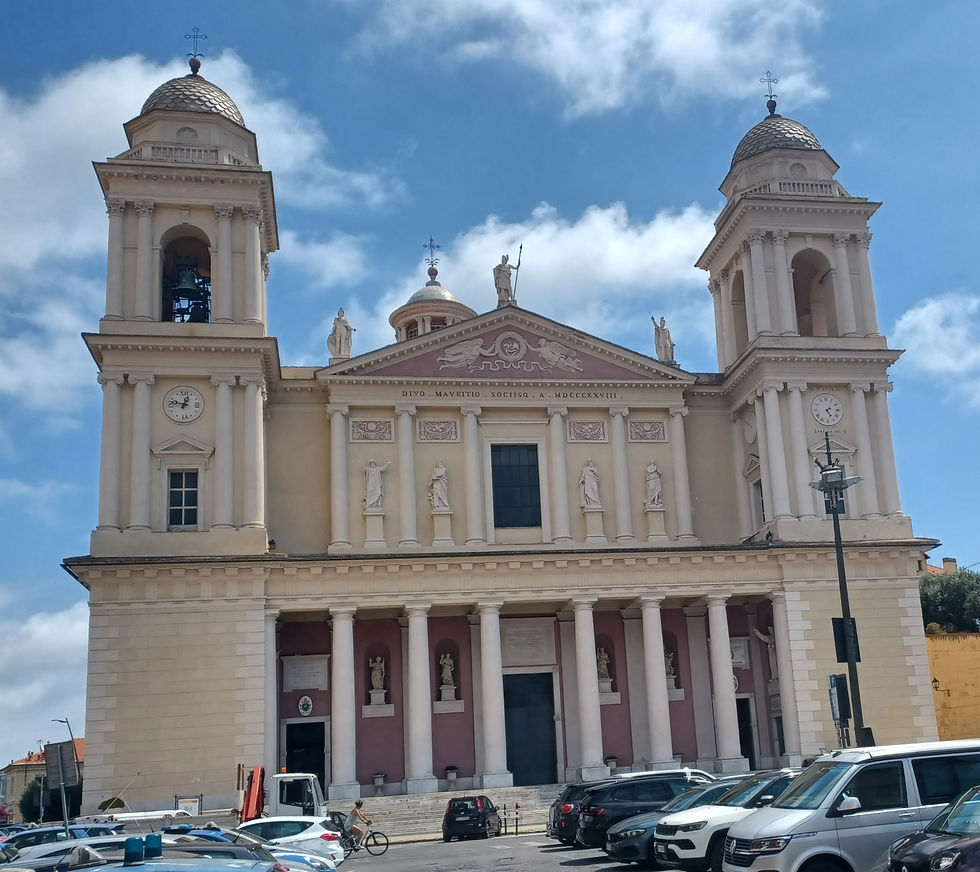
Inside, I was impressed. The plaster fixtures on the curved surfaces of the vault reminded me of (a much cleaner) Grand Central Station in New York City. Full of light (the weather had improved) from the clear glass in the clerestory, there were few stained-glass windows. Quite different, the large lantern dome is over the nave, before the crossing. The daily altar table is forward in the sanctuary, with the cathedra at the south column of the recessed apse. A statue of St Mauritius stands over the high altar, with the dark wooden choir stalls below the exposed pipes of the organ. Above them, more plaster work adorns the half dome. The Stations were different, more diffused – they reminded me of the paintings my grandfather used to create.
Sanctuary of Basilica Concattedrale di San Maurizio e Compagni Martiri, Imperia, Italy High altar, Basilica Concattedrale di San Maurizio e Compagni Martiri, Imperia, Italy Twelfth station, Basilica Concattedrale di San Maurizio e Compagni Martiri, Imperia, Italy Cross sculpture, Basilica Concattedrale di San Maurizio e Compagni Martiri, Imperia, Italy
Leaving the nave, I took a few more pictures, finding an elevated surface to look over the cars parked in front. Moving around a bit, and there was a promenade offering a panoramic view of the port and the Mediterranean. I headed down to the port, and had lunch: a glass of vermentino and a panini of pancetta with pesto. It took three tries to call me a taxi, and 10€ later I was at the station. I chose not to wait 50+ minutes for a local train (Eurail pass) and hopped on the Intercity train with an 8,50€ ticket.
View behind the cathedral of the Ligurian Sea, Imperia, Italy Residences, IMperia, Italy Harbor and marina, Imperia, Italy Lunch of wine and a panini, Imperia Train platform, Imperia, Italy
Back in Albenga, the route to the cathedral took me by the lodgings, so I stopped for the facilities and then continued to the Cattedrale di San Michele Arcangelo / Cathedral of St. Michael the Archangel. Unlike the neoclassic co-cathedral, St Michael’s displays its medieval origin, with a simple plain façade of white stone blocks.

Three entry doors, the western passing through the base of the red brick campanile. Inside, and down steps from the street level, the nave walls and columns supporting the vault are gray stone. The barrel vault in the center, and ribbed vaults of the side aisles are illustrated with medallions and nature images. Those in the center feature the patron archangel.
Nave view to altar, Cattedrale di San Michele Arcangelo / Cathedral of St. Michael the Archangel. Side aisle view of vault, Cattedrale di San Michele Arcangelo , Albenga, Italy Nave view towards enterance, Cattedrale di San Michele Arcangelo , Albenga, Italy Tomb of San Verano, Cattedrale di San Michele Arcangelo / Cathedral of St. Michael the Archangel. Dome and lantern over altar, Cattedrale di San Michele Arcangelo , Albenga, Italy Medieval mural of San Sabastian, Cattedrale di San Michele Arcangelo, Albenga, Italy View into the sub-altar vault, Cattedrale di San Michele Arcangelo, Albenga, Italy Rood screen with the patron saint, Cattedrale di San Michele Arcangelo , Albenga, Italy Exterior view from plaza, Cattedrale di San Michele Arcangelo. Albenga, Italy
The sanctuary is very understated. Old frescoes depict saints, filling the curved back wall. A simple marble altar is in front in the presbytery; the bishop’s wooden throne behind. The lighting was dim, some of the walls looked like they had been in a fire. The fresco survived in the dome, while the carved features on the capitals of the columns have been damaged. I wondered if Napoleon’s soldiers had been through per the French Emperor’s suppression of the Church in the early 19th century.
Leaving, I did a little wander, dropping into the Chiesa Santa Maria in Fontibus with its variable width horizontal stripes. The interior was a sharp contrast to the episcopal see, richer colors and more flourishes.
Exterior of the Church of Santa Maria in Fontibus, Albenga, Italy Central aisle and sanctuary, Chiesa Santa Maria in Fontibus, Albenga Side aisle walls with chapel altars, Chiesa Santa Maria in Fontibus
Back in my flat, I finally got around to backing up 3 days’ worth of photos from the camera, and 5 days’ worth from the phones. While I perused my emails, I sipped on a shot of Macedonian gin over an ice cube from the frig. Late, I submitted my non-report to Florida State for taxes on (no) sales, much overdue.
Common living space, Archivolto dei Teatro, Albenga Bedroom in Archivolto dei Teatro, Albenga Large bathroom, Archivolto dei Teatro, Albenga
I met my neighbors, an Italian couple who arrived without luggage. They brought food in, as I was leaving for my search for supper. Eno – vini e cucina was up beyond the cathedral and on a major shopping street. Sticking to regional wines, I had a ’22 Asinoi Barbera d’Asti with “bar nibbles”, and then with the cheese platter (battuta di manzo, ciliegie, ravanello, aringa), beef tartare: a ’21 pinot nero from Langhe (with a blank front label) and ’21 Rosses di Dolceasqua from Alpicella. The latter was the first time I’ve had a rossese wine. The cheeses were all Ligurian, from a small producer up in the mountains: the chevre was the only one I liked.
Entrance to Eno, Albenga, Italy Entry space at Eno, Ajbenga Appetizers of olives and First wine, Carussin, a Barbera d'Asti Menu at Eno, Albenga
Rossese di Doleacqua, my second tasting Beef tartare at Eno, Albenga A Pinot nero from Langhe, for the cheese Ligurian cheese platter at Eno, Albenga Storefront at nighttime, Albenga Narrow street at night in Albenga
As I strolled back, I stopped and took a few night pictures with both the phone and the Nikon, which I’d brought with me. Streets were quiet but well lit, and the band in the taverna under my window was winding down. I slept well.
Day 114 Sanremo I
Although my alarm was set for 8:30, the noise from the street had me up at 8. Descending miserable stairs, I was out and on my way at 8:50 and off to the station. My train departed from a standalone platform, so I used stairs to get the bags down to the subway, and after crossing, up more stair to wait on the train. With my luggage in front of me, I sat in the between space, riding for 3 stops and 50 minutes to San Remo.
The rugged Mediterranean coast, with mountains descending to the sea, caused the train system to bury the very modern station well under the hill in Sanremo. It was a good 10-minute walk just from the platform to the doors out of the station. Down a slight slope (Maps had suggested climbing the stairs to cut a corner through a park) and to the right, the streets of Sanremo are lined with mature trees. Less than a kilometer, the turns were minimal, and the sidewalks wide (for the most part.) I was staying in a guesthouse on Via Palazzo, a pedestrian street that teemed with tourists and was wall-to-wall shops.
Arriving without instructions, I lucked out to have the door and gate opened by two French young women, and I was faced with two long flights (43 steps) to get to the entry. I had no response from ringing the bell, so I used WhatsApp, and a young Italian woman arrived 10 minutes later. Shown to my room 605, and after paying the city tax, given multiple codes, and shown how to work the doors, she went off to her concierge duties and I pulled my Nikon and hat out. I headed downstairs to the street and continued walking away from the station.
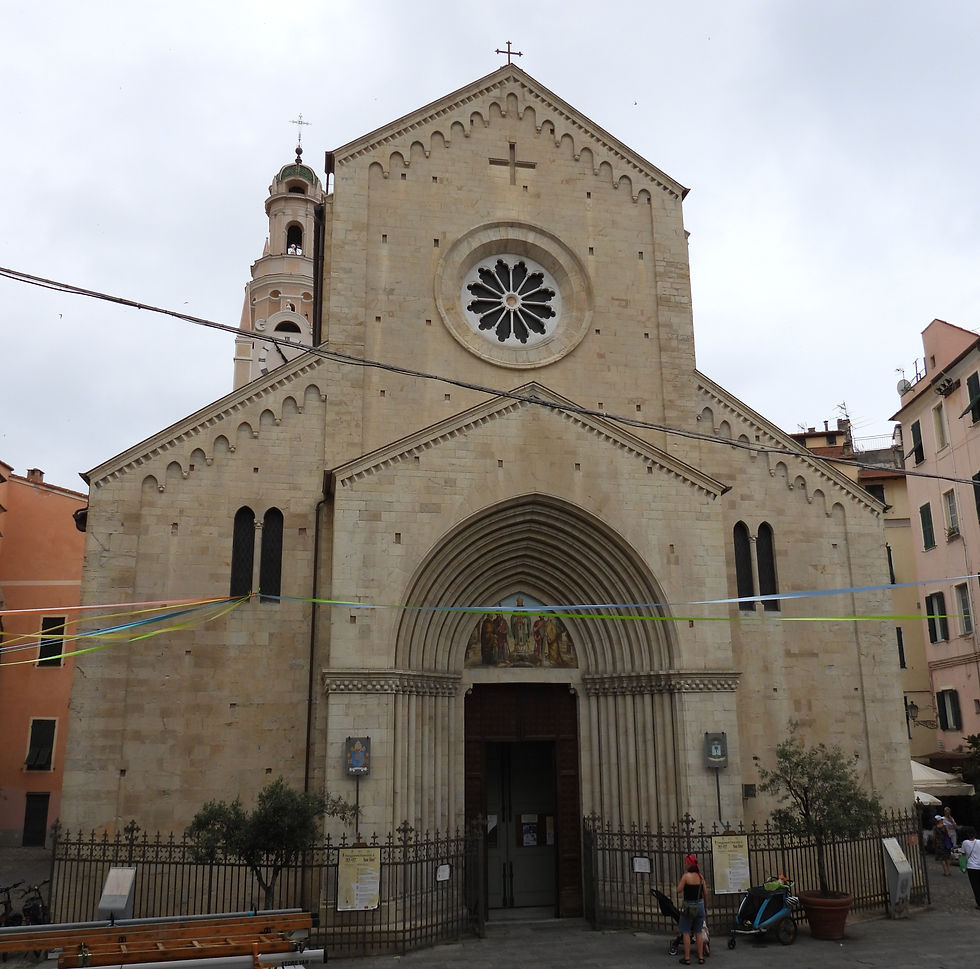
Another 5 minutes and I was approaching the Basilica Concattedrale di San Siro / Co-Cathedral Basilica of St. Syrus. With a “P”-shaped plaza, the entry fronted on the less wide leg of the “p”, while the larger portion was filled with café umbrellas and vendor stands. Tourist streamed the slight incline of the southern façade, crossing the front and slowly moving on. Arriving at ten before eleven, I knew I had time before the building closed for lunch at noon. I moved around the front, patiently waiting for the throngs to clear, finding the shot which included the clock- and belltower over the north transept.
Naveview towards altar, Basilica Concattedrale di San Siro / Co-Cathedral Basilica of St. Syrus High altar, Basilica Concattedrale di San Siro / Co-Cathedral Basilica of St. Syrus, Sanremo, Italy Cathedra (bishop's seat), Basilica Concattedrale di San Siro / Co-Cathedral Basilica of St. Syrus Lectern, Basilica Concattedrale di San Siro / Co-Cathedral Basilica of St. Syrus, Sanremo, Italy View from altar corner into nave, Basilica Concattedrale di San Siro, Sanremo, Italy
The co-cathedral is a smaller, simple three-aisle church. The white stone blocks of the aisle walls and the supporting columns-and-arches hold up a flat timber vault. The sanctuary consists of two smaller side chapels, the south dedicated to the Sacred Heart, the north to Mary, Queen of Heaven, and the apse with the high altar holding a large covered tabernacle and the altar table at the front edge of the presbytery. The organ and its pipes are in the loft over the entry. While the walls are close to bare, there are displays of old fresco fragments, the Stations, painting of the patron saint. The lectern is modern, carved from a taupe marble, depicting a preaching Christ.
As I left about 11:30, a young priest had close the side door and was hovering by the gate. At 11:45 the gates closed for entry, and, after a sweep of the inside, he locked the front door. On the Via del Pace (the head of the “P”), the Oratorio dell'Immacolata Concezione faces south into the square. Having a recommendation to visit, I walked up the stairs into the nave. The center aisle split the pews; the walls of the nave are covered with monumental paintings retelling the story of the Virgin Mary. While the barrel vault in the nave is plain, the ceiling over the sanctuary displays an allegory of heaven, with God the Father central to the fresco. In a niche behind the high altar, a white marble statue representing the Immaculate Conception stands. This was a stark difference from the episcopal seat!
View from nave to the altar, Oratorio dell'Immacolata Concezione, Sanremo Vault over the sanctuary, Oratorio dell'Immacolata Concezione, Sanremo Two of the paintings depicting the story of Mary
After a few more shots of the cathedral, I headed through town to the train station. Aiming for the 13:49 train, I arrived as a late train pulled in, so I boarded for the 3-stop ride. Ventimiglia is the junction for the French and Italian coastal trains, so everyone on the train got off. I checked Maps, and began walking the kilometer west.
Narrow street in Sanremo, Italy Plaza with diners, Sanremo, Italy Curved street in Sanremo, Italy Roya River in Ventimiglia, Italy View of brisge and city of Ventimiglia
I crossed the Roya River and wound around the Piazza della Costituente before reaching the Piazza Cattedrale. I tried waiting out the 5 7yo boys on their bikes and scooter, as they were whizzing around the plaza.

The circa 1100 Cattedrale di Santa Maria Assunta / Cathedral of Our Lady of the Assumption faces northwest to the piazza with a single door. The exterior of the façade is stone blocks, of many shades and hues. An addition on the northeast is faced in orange stucco, with a dome and a clock- and belltower over it. Entering into the building, there are four aisles, with that addition becoming the fourth. The aisles run to three altars: from right to left, the Eucharistic altar with a tabernacle, up steps to the sanctuary with the altar table, and an altar with a painting representing the Assumption, with statues of Catherine of Siena and Anthony of Padua.
Dome with frescoes, Cattedrale di Santa Maria Assunta / Cathedral of Our Lady of the Assumption Sanctuary and altar, Cattedrale di Santa Maria Assunta / Cathedral of Our Lady of the Assumption Icon of the Virgin and Child, Cattedrale di Santa Maria Assunta / Ventimiglia, Italy Stairs to the crypt, Cattedrale di Santa Maria Assunta / Cathedral of Our Lady of the Assumption Original baptismal font inthe crypt, Cattedrale di Santa Maria Assunta , Ventimiglia Fresco on wall of crypt, Cattedrale di Santa Maria Assunta / Cathedral of Our Lady of the Assumption Archeological finds, Cattedrale di Santa Maria Assunta / Cathedral of Our Lady of the Assumption High altar, Cattedrale di Santa Maria Assunta / Cathedral of Our Lady of the Assumption, Ventimiglia Newer dome vault, Cattedrale di Santa Maria Assunta / Cathedral of Our Lady of the Assumption Crucifixion painting, Cattedrale di Santa Maria Assunta / Cathedral of Our Lady of the Assumption Main entry doors, Cattedrale di Santa Maria Assunta / Cathedral of Our Lady of the Assumption Aspe wall in rear of Cattedrale di Santa Maria Assunta / Cathedral of Our Lady of the Assumption
An octagonal dome features frescoes: a martyr at the center, with individual angels in the surrounding panels. Walls from the original building are raw stone blocks, similar to the outside but cleaner. Stairs on either side of the sanctuary descend, one side to the baptistry with a full immersion font; the other into the crypt. This is definitely an interesting older cathedral, well worth the visit. It is the bishop’s seat, with St Syrus in Sanremo, the co-cathedral when the dioceses were combined.
A cafe sits on the piazza, with a wall overlooking the river and the city, with a view of a beach. Taking an alternate way down the hill, I passed through small arched covered walkways, as I descended towards the bridge over the river. I caught a train east to Sanremo, walked through town and climbed the stairs to the room. Staying for 2 nights, I opened the big bag on the floor, pushing it into a corner.
View of Ventimiglia coming down the hill fromt he cathedral View of the beach in Ventimiglia at the mouth of the river One of many covered walkways I took journeying down the hill Streets of Ventimiglia, Italy Pubic art / graffiti in Ventimiglia

Turning on the air conditioning and pulling off my shoes, I lay back on the bed and did Facebook and emails. About 7, a group of young women arrived, quite noisily. I decided it was time for dinner and left their chattering behind. Heading towards the cathedral, I stopped before walking to the rear and found Café Matisse, a wine bar.
I started with a white, a ‘23 Lunae vermentino Colli di Luni. It was pleasant, refreshing and minerally, as expected. A small plate of food arrived, which I found uninspired. I was ready for a red, and they brought me a barbera d’Asti, but it had turned. No other local reds available, so another white, a ’23 pigato from Cascina Fèipu del Massaretti, Riviera Ligure di Ponente: this a Ligurian native varietal, and an artisanal wine from Albenga. Interesting, but not one I’d return to often. Trying to recover my favor, they brought an over-aerated ’22 Montepulciano d’Abruzzo from Privano. To soak up the wine, I had an order of pasta al pesto, with not enough grated parmesan cheese.
Appetizer platter at Cafe Matisse, Sanremo, Italy ‘23 Lunae vermentino Colli di Luni. first taste ’23 pigato from Cascina Fèipu del Massaretti, Riviera Ligure di Ponente Pasta al pesto, lacking grated parmesan cheese ’22 Montepulciano d’Abruzzo from Privano
Day 115 Sanremo II - Monaco
Waking to the alarm, I was quickly out and heading to the train station. I’d planned on the 9:31 westbound train, but the 9:01 was pulling into the station so I boarded and rode to Ventimiglia where I switched trains to cross the frontier at Ponte San Ludovico into France. Many offloaded at Menton, the first stop, while I continued to Monaco. (Yes, a new country for my list.)
Out of the train station, I followed the one-way traffic west towards the water. It was a climb, wide steps, a path with switchbacks, but it got to the top, a plaza which seems to be a tourist meeting point. Since it was near the palace, I knew the cathedral was nearby.
Street scene in Monaco Butte in Monaco where the castle and cathedral are View of the Principality of Monaco from the butte Street scene in Monaco's old town
Unfortunately, when I got there, across the street in the shady spots (which, of course, are the better photo vantage points) were filled with guides and their groups. After spouting off their spiels, they all crossed the street and headed up the stairs, the guides slipping off to the side awaiting their return. Rinse and repeat.
Nearby, I spotted a young woman winding her camera. She had a plastic camera and was using film, so I asked how she had found an interest in classic photography. A Swiss from Geneva, we chatted for a bit, both of us waiting for our shots. And we agreed that the guides were the worst, hogging the best locations for too long.

Fifteen minutes later, aggravated at the white SUV parked out front, I crossed the street to ascend the steps and enter the Cathédrale Notre-Dame de l’Immaculée Conception / Cathedral of Our Lady of the Immaculate Conception. A tall block over the three entry doors, this turns out to be the narthex. Passing into the nave proper, light wood pews with red seat cushions fill the central space. Columns support the galleries over the side aisles and the vault overhead, and small devotional chapels line the outside walls.
Much of the central nave was cordoned off, directing visitors off to displays, altars and artwork. As usual for me, I sought the Eucharistic chapel, this time getting past the gendarme, and went in to offer my prayers for my growing list. There is an ambulatory, so I walked it in both directions, as I’ve found I don’t see everything on a single pass. This path around the high altar is the resting place for the deceased members of the Grimaldi family.
Nave and vault view of the Cathédrale Notre-Dame de l’Immaculée Conception in Monaco-Ville High altar of the Cathédrale Notre-Dame de l’Immaculée Conception in Monaco-Ville Medieval altar triptych The Notre-Dame Cathedral in Monaco Seating in the quire for the Grimaldi royal family in the Monaco Cathedral Ambulatory chapels of the burial places for the Royal Family of Monaco in the Cathedral Mosaics in the apse of the Cathedral of Assumption of Mary in Monaco Rear of the cathedra (bishop's throne) from the ambulatory in the Monaco Cathedral A view across the transept with the altar, Monaco Cathedral Gilded altar in the crypt of the cathedral in Monaco Crypt dome in the cathedral in Monaco Dtsinrf glass window of St John the Evangelist (bearded!) Carving at the crossing of St Matthew the Evangelist
A descent into the crypt yielded a view of a stunningly ornate, filigreed golden altar and tabernacle. The workmanship was amazing. I studied the capitols of the columns, as they were much closer in the low-ceiling of the space under the presbytery.
The cathedra sits at the back of the apse, its back close to the ambulatory. The Prince and his family have special seating at the side of the sanctuary, so no privacy there. Mosaics of the apostles fill niches around the sanctuary, which I felt captured by – probably having seen many while in the Balkans. I asked but was denied when I requested access to the gallery to get a higher view of the nave.
tritych Winged bull sculpture above the cathedral corner Carvings above the cathedral entry doors Entry door detail: Holy Trinity with the Virgin Mary
Back to the sunlight, I took more outside shots, including zoomed shots of the many winged griffins placed on small ledges. Heading past the palace, I returned to the plaza and strolled through the vendors, checking for a budget t-shirt.
Royal Palace of the Principality of Monaco View of the waterfront through trees in Monaco-Ville Eastward looking view of Monaco from the butte of Monaco-Ville
The lowest I found was 10€, and I didn’t really need another t-shirt. More shots of the marina as I walked down the path into Monaco-Ville. By 1pm I was underground, using moving walkways to bring me to the station.
Underground train station walkway in Sanremo Underground moving walkway in the Monaco train station
I caught the train back, making the change in Ventimiglia, and by quarter to three, I was sitting in the shade at a café on a piazza, sipping a vermentino and having a last Italian cheeseburger. Since the cheesecake came with a raspberry topping, I had a piece with coffee for dessert.
A glass of vermentino with a late lunch in Sanremo Cheeseburger and chips for lunch in Sanremo Cheesecake topped with raspberries, capping lunch in Sanremo
Back earlier than I’d planned, mostly because I didn’t really explore the Principality beyond visiting the cathedral and walking past the palace, I had time to head back to the B&B, climb to the room, and take a nap. When I was getting ready to take a quick shower, I realized I’d left my string backpack at the café, so I dressed and headed back, safely recovering my gear. Since it contained my passport, its loss would have been a major headache.
Laying down when I got back, I relaxed until the young children of the guests next door returned and were probably wired on sugar. I took that shower and dressed, grabbed my journal and headed back to the street and looked for another wine bar for the evening. By the Porto Vecchio, I had a table on the sidewalk and luckily away from smokers. My back was towards the port, as it was a long block to the water. I started with a local Moscato di Taggia, a small inland town halfway between Sanremo and Imperia. “Il Dottor Antonio” came from Podere Don Zella. The cafe served me small triangles of focaccia, and I moved on to a local garnacha/grenache, called granaccia in Italian. It was from Rovebella in Santo Stefano al Mare, on the water and near the first vintner. The last wine was a ’23 Il Nebbio from Langhe, produced by Pio Cesare. Mainly a wine bar, food was very limited, but I ordered a “toast” to put something in my stomach as it had been 5 hours since my burger snack.
Moscato di Taggia “Il Dottor Antonio” came from Podere Don Zella A glass of Moscato with a plate of focaccia segments Bottle of granaccia from Rovebella and nebbiolo from Pio Cesare Cheese toast supper

You can purchase your own copy
(or have me send it as a gift) of
Cathedrals to the Glory of God
by clicking this link:
Volume II has been released

You can order your personal copy
(Print on Demand)
Cathedrals to the Glory of God
Volume II
by clicking this link:


Comments