Périgueux and Clermont-Ferrand

Day 126 – Périgueux I
Up at 8, out at 9, it was a slow stroll to the train station in Cahors via the “shorter route”. My train was still going to be a long wait, so I hopped the earlier train to Brive-la-Galliarde, figuring I’d store the bags and wander. But by the time the train reached the station, it was spritzing too heavily for just the t-shirt I was wearing. Luckily, I found a padded seat, in which I sat for a couple of hours reading and munching on my rillette-and-baguette lunch I threw together the day before.
Finally the train to Périgueux was called. Two carriages, full (on a Sunday afternoon!), so I lay my bags down in the open space and found a seat. I did more reading, and figured out which other books in the Bruno series of Martin Walker I needed. Which calls for an explanation. While I’d hoped to see 3 cathedrals while staying 3 days in Périgueux, the real reason for the sojourn was to spend time in the area where a police procedural series was set. Dating back to Town Centre Books in Pleasanton (California) when proprietress Judy introduced me to Bruno, Chief of Police in 2009, I’d enjoyed and kept up with this series; when planning, I’d hoped that my friend Mandra could join me, as she (and her mother) are also fans. But I would be going solo in the Vézère River valley, matching the real to the fictional village of Saint-Denis.
Continuing with the bad weather vibes, exiting the Gare de Périgueux, I had an overpass to climb to head to my hotel. Horrendous sidewalks for roller luggage almost all the way, I finally reached the ibis Budget Hotel. The front desk futzed, slowly getting to my registration, and getting me the 6-digit code I’d be using throughout the stay. Up to room 208, there was a small desk for writing and backing up photos, a small window and limited floor space (but near the path from bed to WC.) It was just after 4pm, so I broke open the big bag, pushing it to a corner, dug out the toiletries, and then decided to find the local cathedral.
Room 208, ibis Budget Hotel, Périgueux Bathroom for Room 208 at the ibis Burget Hotel, Périgueux Arch into pedestrian space, vieux-ville, Périgueux
Périgueux is a tourist city, the capitol of the Dordogne department. The section of town from the train to the hotel may have been the less desirable or visited. Cresting a mild ridge, glitzy shops, marble plazas and historic buildings began to appear. Arriving at the Cathédrale Saint-Front de Périgueux, as I was finding my angles, a guy stated that it is the only Byzantine cathedral in France. From the Place de Clautre west of the main entrance, it is difficult to see the 5 domes over the transept and crossing. I learned that the better views were down near the Isle River.

Another very large cathedral, the west gate is part of a plain-front archway which allows for a descent through a passage under the impressive belltower. It acts as a narthex. Entering the nave, the stone walls are plain; massive chandeliers hang from the center of the domes above. The center dome is at the crossing, with a large square raised platform presenting the square marble-topped altar. The pews for the congregation filled the 4 arms. An equal-armed Greek Cross footprint, the east-west axis is extended by the narthex and an apse. Ahah! The Byzantine reference.
The view overhead when passing through the belltower, Périgueux Cathedral Lectern, Cathédrale Saint-Front de Périgueux "Le Retable", reredos altarpiece, Cathédrale Saint-Front de Périgueux View of western arm towards belltower, Cathédrale Saint-Front de Périgueux Three stained glass windows, Cathédrale Saint-Front de Périgueux Main altar and chandelier, Cathédrale Saint-Front de Périgueux
Filling the apse is a stunning carved wooden reredos “Le Retable” depicting the Assumption, filling the entire width. Both the north and south transept arms had entrances, although only that to the north was open. Stained-glass windows seem to date to the early 20th century, while older faded remnants of murals are preserved on the walls. With less “fuss and clutter”, I enjoyed this visit.
Exiting through the north entry, a better view presented, with the 5 dome caps and the bell tower all visible. The building uses a white/yellow stone, as do many of the buildings in Périgueux, almost feeling bland. Heading down towards L'Isle River, several tall trees impaired a clear appreciation for the east end. Along the riverfront, cafés and pubs had concessions, families were out with small children, folks were on vessels (including paddle geese and flamingos) in the stream, pétanque courts were in use.
View down a narrow street in Périgueux Raised older riverfront building, Périgueux View of L'Isle riverfront park, Périgueux Flamingo paddleboat, Périgueux A view of the Périgueux Cathedral from the riverfront Al fresco dining area, riverfront, Périgueux Two pétanque courts, riverfront park in Périgueux
Nearby was supposed to be the former cathedral, the ex-Cathédrale Saint-Étienne-de-la-Cité de Périgueux. With the consecration in 1669 of St-Front, it became a parish church.
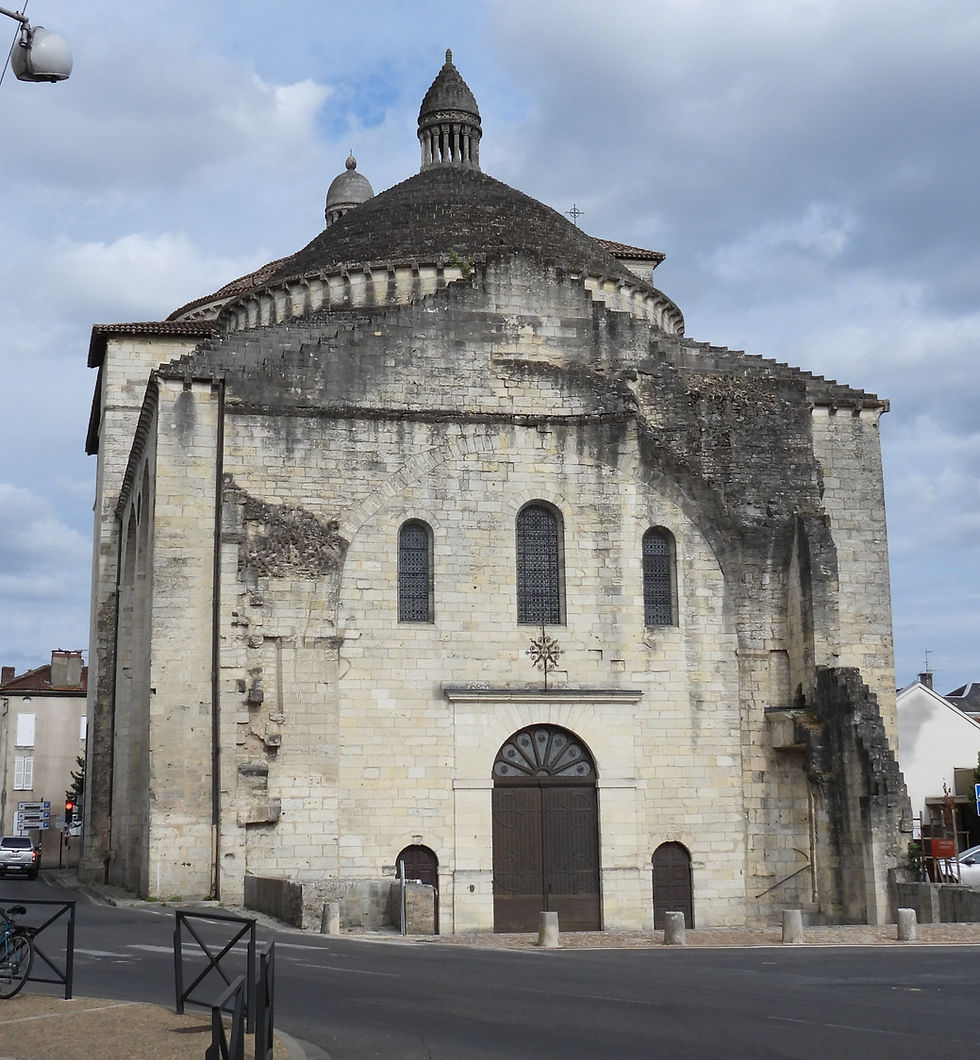
Set well back from the river, but not on the rise, the footprint is two dome-capped cubes aligned east-to-west. Inside, a single aisle, plain walls, the sanctuary in the east end, its wall a series of simple columns and arches. A reredos of carved walnut stood near the back corner, probably meant as a replacement for La Retable which had been in St-Etienne until the 1974 relocation to the cathedral apse. I found the carving handiwork to be amazing.
View of nave towards altar in St-Etienne-de-la-Cité, Périgueux Raised altar table in the sanctuary, St-Etienne-de-la-Cité, Périgueux View of the nave looking to the entry door, St-Etienne-de-la-Cité, Périgueux Carved wooden reredos, St-Etienne-de-la-Cité, Périgueux Baptristry space and font, St-Etienne-de-la-Cité, Périgueux Bas-relief carving on wall, St-Etienne-de-la-Cité, Périgueux
It appeared preparations for Sunday evening Mass were underway, so I left and walked through the Square des Arènes, a lovely small park with archeological findings on display. It was the site of a Roman amphitheater, roughly the diameter of the length of the current cathedral.
Roman amphitheater archeological ruins, Square des Arènes, Périgueux Display, Roman amphitheater of Vesunna, Square des Arènes, Périgueux Model, Roman amphitheater of Vesunna, Square des Arènes, Périgueux Roman amphitheater archeological ruins, Square des Arènes, Périgueux Roman amphitheater archeological ruins, Square des Arènes, Périgueux
Returning to the hotel, I asked for ice without success. Pulling up Maps, I searched for a wine bar, and returned to the commercial center near St-Front. La Clarté du Vin opened onto the street, had a substantial “Vin du Moment” list on a blackboard, and I was pleased. I started with a ’21 Pécharmant from Chateau Neyrac with a block of foie gras and Spianata romana charcuterie to eat. Two wooden platters and a basket of bread arrived with my wine and I was set for the evening. My second glass was a ’22 Les Terres Chaudes from Chateau le Hauts de Caillevel. Madame, my hostess, insisted that I end my repast with something sweet, pouring a ’17 Monbazillac from Chateau Le Terme Blanc: perfection. [This lovely after dinner wine is often mentioned in the Bruno books as a real treat. I concur.]
"Vin du Moment" at La Clarté du Vin, Périgueux Menu at La Clarté du Vin, Périgueux Bottle of ’21 Pécharmant from Chateau Neyrac at La Clarté du Vin, Périgueux Foie gras platter at La Clarté du Vin, Périgueux ’22 Les Terres Chaudes from Chateau le Hauts de Caillevel at La Clarté du Vin, Périgueux Spianata romana charcuterie at La Clarté du Vin, Périgueux ’17 Monbazillac from Chateau Le Terme Blanc at La Clarté du Vin, Périgueux Tourist (selfie) signage in Périgueux
My hips had been cranky walking to the wine bar, so I journaled that I hoped for less walking when I went to Sarlat the next day. In the Bruno books, Périgueux was the departmental headquarters, while regional administration was in Sarlat. (Serious police business was handled in Bordeaux or Paris.) It had been unusually cool, temperatures in the 60’s (°F), and I’d pulled out the sports jacket for the evening.
Day 127 – Périgueux II (Sarlat)
Two regional trains were my means of transportation – there is a quick change in Le Buisson. Getting off in Sarlat, I had a 1½km walk north to get to Sarlat-la-Canéda where the old city attracted tourists. While walking, a MIG buzzed the city (moving too fast to take a picture.) Streets seemed closed for pedestrian use only, vendors had tents and market umbrellas to display their wares out of the intense sun overhead. The ex-Cathedral of Saint-Sacerdos at Sarlat had been an episcopal seat from 1317, the building dates from the 16th-17th centuries. The diocese was absorbed to Périgueux in 1801.
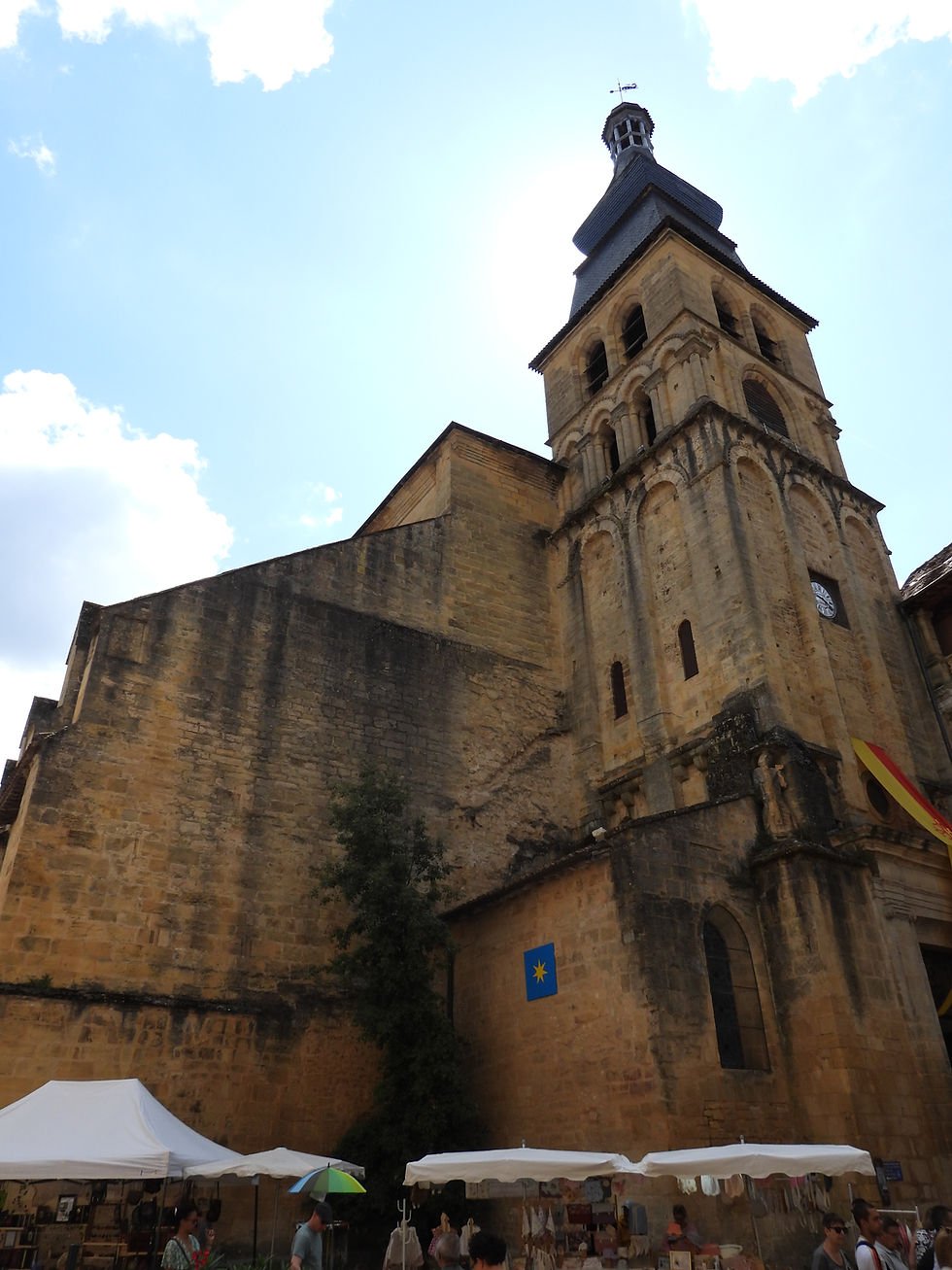
Concessionaires, entertainers, and tourists all continued to use the small space in front of the ninth century belfry and entry on the Place du Peyrou. A troop of scouts spent time resting on the steps. Seeking a view without crowds of people, I went around to the north side, climbed stairs to terraces outside an exhibition space. Descending, I moved as far around the apse as I could, snapping away. Giving up that a cloud might come by and reduce glare, I headed inside. Narrow side vaults offered three chapels each. The vaults were arch ribbed, the tall and narrow stained-glass probably late 19th century in high walls.
Exterior signage, ex-Cathedral of Saint-Sacerdos at Sarlat Naave and vault, ex-Cathedral of Saint-Sacerdos at Sarlat View of side aisle, ex-Cathedral of Saint-Sacerdos at Sarlat Sanctuary and altar, ex-Cathedral of Saint-Sacerdos at Sarlat Entry wall with mounted organ pipes, ex-Cathedral of Saint-Sacerdos at Sarlat Carved wooden quire stalls, ex-Cathedral of Saint-Sacerdos at Sarlat Misericord (detail), choir stall seat, ex-Cathedral of Saint-Sacerdos at Sarlat Stained glass window, ex-Cathedral of Saint-Sacerdos at Sarlat
The active altar is placed on a raised platform ahead of the sanctuary, where the Presence is at the high altar at the back of the hexagonal apse. There appear to be two organs, with a massive display of pipes over the entry doorway. In the choir, I found misericords under the seats in the choir, always a find. As I exited, I began a wander, noticing how city elders’ efforts had been made to maintain the historic past. The marche was open, in an annex in front of some buildings. In the pavement, I found a bronze marker for Sarlat, unsure of where it was directing me. I finished my leftovers from the day before, continuing to seek venues with fewer tourists. Periodically I’d return to the cathedral façade, check from the near-perfect vantage spot.
Climbing a hill, I got into private land, full of trees near the houses, and sunny plots with vegetables and vineyards. I was wearying, so I sat at a tapas place and nursed a glass of Bergerac rouge for an hour. I met a couple from Winston-Salem, with 4 kids under 10; they had returned to stay in the house they’d honeymooned in and bought. (A local agency had been managing it, renting it out.) Passing through by the cathedral again, the light cooperated for my shot, and I began the trudge back to the station.
Train bridge over Le Cuze river, Sarlat View between buildings in Sarlat Pavement marker, Sarlat Pedeatrian street in Sarlat Pedeatrian street in Sarlat Turret behind bouganville flowers, Sarlat View of neighboring buildings, Sarlat Street vendor selling foie gras, Sarlat Tapas place where I chatted with a NC family, Sarlat Old printing press, Sarlat
With an hour to wait, I’d hoped for a bar or café, to no avail. The change in Le Buisson had a 45-minute wait, and again no services. I had snapped a few shots of the countryside to send to Mandra.
View from the train carriage between Sarlat and Périgueux View from the train carriage between Sarlat and Périgueux View from the train carriage between Sarlat and Périgueux View from the train carriage between Sarlat and Périgueux
When I got back to Périgueux, I made a pit stop at the room, collecting the journal and left the Nikon. Wanting to stay in the less commercial end of the city, I tried Bistro Régent, which faces out onto an esplanade near the theater. I started with a Bergerac blanc, which turned out to be sweeter than my taste. With my poitrine de poulet grille came frites and a salad. I switched and had a glass of Pessac-Léognan rouge. My notes say I had all of the salad and perhaps a quarter of the potatoes.
Day 128 – Périgueux III (Le Bugue)
The general area in France that I was visiting is the Department of Dordogne. This day I was going to a tiny village called Le Bugue, about 10 miles west of Sarlat and 15-20 miles south southeast of Périgueux. It is the town that Martin Walker models the fictious Saint-Denis on. For reference, the Dordogne is east of Bordeaux a bit less than 90 miles / 135km.
The train I planned to take would leave at 9:41, so I was up at 8:30 and on that train. Sixty-five minutes later, I was the sole passenger getting off in Le Bugue. It was a 2km walk northwest over a flat path and then sidewalks to get into the heart of the town. On my way, I stopped at a glass-blowing factory “Pand Glass Souffleur de Verre“ to join a demonstration. Practically next door was the aquarium and Le Big Bird, an amusement park, which borders on the Vézère River. [Both feature in some of the Bruno books.]
Road from the train station as it approaches Le Bugue Jnside the glassblowing shop: Pand Glass Souffleur de Verre, Le Bugue The Big Bird amusement park, Le Bugue View of the Vézère River as it passed Le Bugue
Parallel to the river, the Rue de Republique arrives in the center of the town at a rotary where four major roads conjoin. To the southwest, the Avenue de la Libération bridges the river. Rue du Jardin Public heads towards the firehouse and points west. Rue de Paris, and Grand Rue pass through the commercial parts of Le Bugue, eventually heading north. In an open-air marketplace, a circular roof covers multiple vendors while overlooking the river. It was Market Day in Le Bugue.
Vegetable seller stall, Le Bugue market day Truck selling cheeses, Le Bugue market day View of the open air market, , Le Bugue market day Dried sausage vendor, Le Bugue market day Herbs and plants for sale, Le Bugue market day Flats of tasty strawberries, Le Bugue market day Olive vendor offered garlic cloves, Le Bugue market day Another fromagerie, Le Bugue market day Nougat vendor, Le Bugue market day Black truffles offered, Le Bugue market day
I wandered both in and around the pavilion, snapping pictures of wares for sale, shoppers perusing all sorts of goods. Most appealing to me were the saucisson, cheese, olives-and-garlic, and bread vendors. Wood carvings, clothing, fruits and vegetables, baskets, jewelry and confections were all available, multiple times. A church’s spire soared over the crowds, and for a few minutes of quiet, I entered l’Église Saint-Sulpice.
Taking another break from the crowds, I walked Rue de Bellvue, which promised a view. While mature trees hid the panorama of the surrounding valley, tiled-roof homes lining narrow roads.
View from Rue de Bellvue, Le Bugue View from Rue de Bellvue, Le Bugue View from Rue de Bellvue, Le Bugue
Back to the base of the hill, I wandered over to the Rue de Paris, crossing a small channel and seeing the back of the church. A very still retention pond reflected the partially clouded sky and the adjoining buildings – a great shot. A wine shop, which I remember from the books, proved ad interesting stop – not only the local Périgord vintners, but right bank Bordeaux offerings as well.
Channeled small stream feeding into the Vézère in Le Bugue Rear of the St Stephen's Church in Le Bugue Arty shot: buildings reflected in the Bassin de la maison de retraite in Le Bugue Arty shot: Church reflected in the Bassin de la maison de retraite in Le Bugue Wine venndor's offerings, Le Bugue
Following the river east until the amusement park as I bid farewell to the petite ville du Bugue, I felt satisfied at living a bit of the Bruno stories. Walker hosts trips in April, but I’m not fanatical enough for that crowd. I read his books for enjoyment: the fictious Bruno is 40yo single Frenchman, veteran, dealing with being a one-man local police force in a small town. There are always history, cooking, wine, dogs and horses in most books, plus his repeated romantic failures.
Back to the station, after stopping at a small market for water, I found I had an hour wait. No services, I had to find a tree to relieve myself. Once back in Périgueux (after a shot or two of the cathedral from the train) I shopped a Carrefour for a mini baguette and 2 chocolate bars.
Fenced field along the Rue de la Republique, leaving Le BUgue Train tracks at the Le Bugue station View from the train of the Cathedral of St Front
I’d picked up goodies while at the market in Le Bugue: cheese, saucisson, fruit&nut mix, so with the Macedonian gin, I’d be set. I wasn’t particularly hungry, and I had an earlier start in the morning. I read and did email before repacking and getting to sleep.
Day 129 – Clermont Ferrand I
With an alternate to my 3-train midday ride in my itinerary, I would only have to change twice, so I was up before 8 and out at 8:15. Early to the train station, I had to wait for the announcement as to which Voie (track) the train to Limoges would be at. Once announced, the lift was at the far end, so I rode up, walked across and descended on the lift before moving to mid-platform. A single carriage pulled in, and I got my bags into the rack and found a seat.
View of the train engineer's space Passengers loading their bicycles onto the train in Limoges View from the train before it approached Montluçon
At Limoges, there were 8 minutes to change trains, but the single-car Montluçon train was directly across the platform. My luggage went into a rack, and I joined 3 others in a 4-seat section. Two hours aboard, and we pulled into Montluçon. Again, another 1-carriage train was across the platform, but it had no luggage space, so I used the velo (bicycle) area. I had my packed lunch, took my meds (which I’d forgotten the day before) and rode to my destination of Clermont-Ferrand.
After getting to one end of the station, I found Google Maps wanted me at the other end, under the tracks. At the second intersection I discovered why Maps wanted me on the other side, as there was significant roadwork underway, and taking a straight path meant gravel, curbs, blockage signs and heavy work – all of which I maneuvered. I got through it, continued until I got to the Hotel Beaulieu.
Probably the worst place I’ve stayed, it was a dump. I had room 4 on the first level, a single bed in a narrow room and a small bath. One window with a portable AC unit, blowing out into a courtyard where a baby screamed non-stop. Pipes in the paper-thin walls seemed to never stop banging. But I sucked it up, asking the front desk to please speak with the mother to try to keep the child quiet.
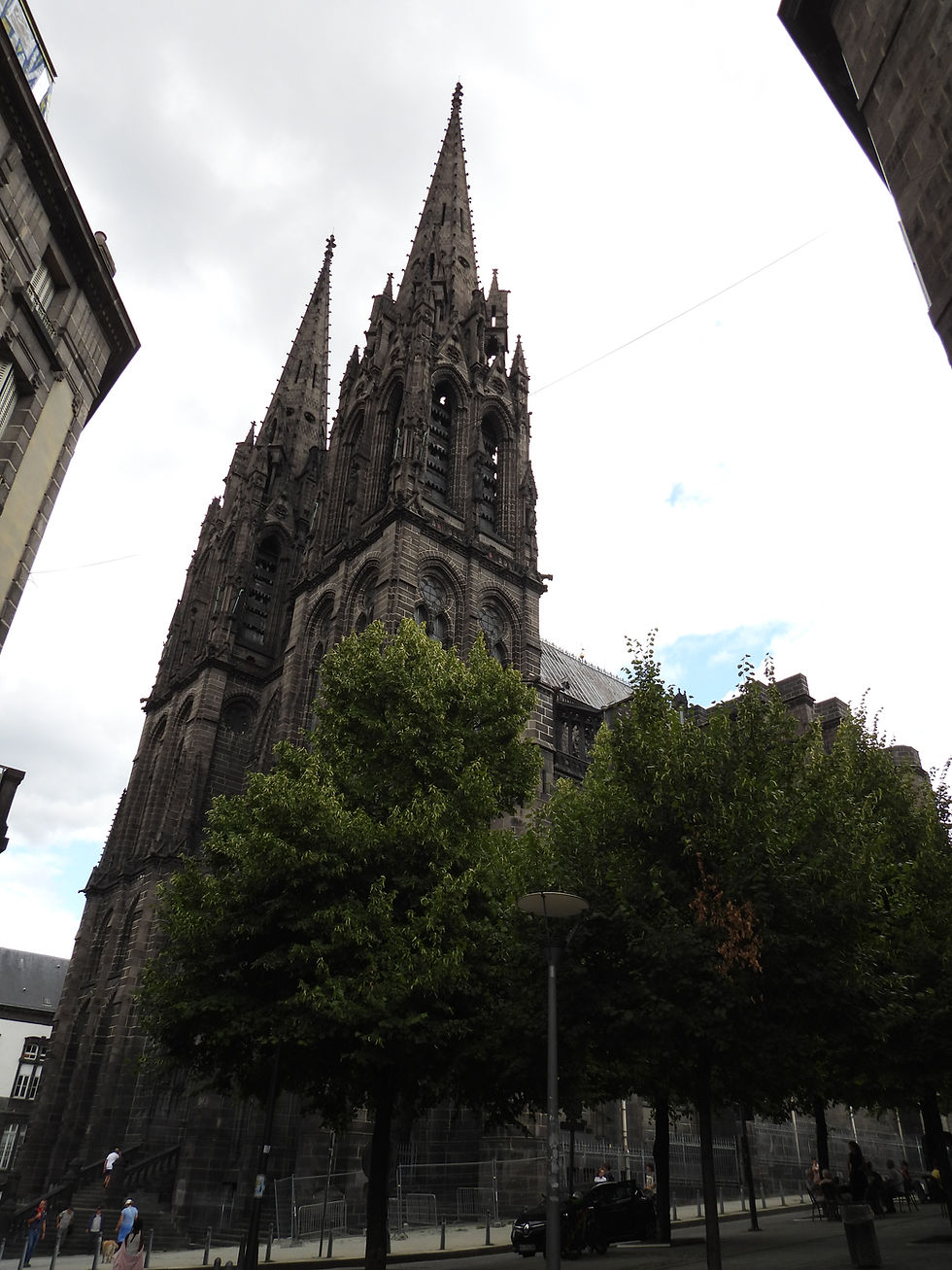
Leaving the hotel, I headed up into the “old city”, a walk of about a kilometer. Approaching from the south, the dark twin spires of the cathedral’s western façade overlook the descent from the hilltop. The entire exterior of the Cathédrale Notre-Dame-de-l’Assomption is a black stone, the color of dull, tarnished gunmetal. These stones come the region, the Auvergne, which is volcanic in origin. The Gothic structure is massive, 100m long, 33m wide and spires at 95m. While there is clear sidewalk around the entire building, trees grow across the street to the south, the ground drops away sharply to the west, while other buildings press from the north and east.
The gray stone inside seems lighter, the columns rising nearly 30m to the groin vault; two sets of two side aisles continuing as the ambulatory in the apse. Side chapels line the walls, and interestingly, with the exception of the two on the sides of the rear chapel, all the altars in these chapels are aligned to the main altar. Older statues are still defaced (Revolution, and Napoleonic forces) while some frescoes are still extant. The altarpiece at the high altar is gold, with a filigree steeple rising over the tabernacle.
Vault of the Clermont Ferrand Cathedral Stained glass window rear of apse, Clermont Ferrand Cathedral Medieval mural on wall, Clermont Ferrand Cathedral Triptych altarpiece, ambulatory, Clermont Ferrand Cathedral Crypt, Clermont Ferrand Cathedral Diagram of Clermont Ferrand Cathedral footprint
Chancing on a guided tour group, I slipped into the crypt under the sanctuary. Several carved sarcophagi as well as remains from the earlier Romanesque cathedral are on display. The squared cathedral is known for its stained-glass windows, depicting both saints and biblical figures, as well as historic scenes of papal visits. The large rose window in the transept is geometric in design, mainly red with green, blue and yellow. Surmounting the organ loft above the narthex, a circular rose window of green and red is viewed beyond the pipes. Mounted on the wall over the docents’ table, I noticed a clock high up in an arch, three figures used to signal the hours.
Transept arm stained glass rose window, Clermont Ferrand Cathedral Mechanical clock, Clermont Ferrand Cathedral Black Madonna and CHild, Clermont Ferrand Cathedral Transept arm stained glass rose window, Clermont Ferrand Cathedral View of nave seating, Clermont Ferrand Cathedral Pipe organ and rose window, western entrance, Clermont Ferrand Cathedral
When I returned outside, I attempted to photograph the gargoyles and the statue on the dome. Carved from volcanic rock, the flat blackness proved chancy in getting details against the gray sky. Over into the Tourist Office, I picked up a city map. Walking around the area, I encountered a weird (to me) statue, which required me to walk around it. My view is that it is a naked man grasping a wing and the lower half of a warrior angel.
Street view, Clermont-Ferrand Detail of a public fountain, Clermont-Ferrand Street art: mural portrait, Clermont-Ferrand Statue in garden, man grasping angel?, Clermont-Ferrand Statue in garden, man grasping angel?, Clermont-Ferrand
When I got to the hotel, I exchanged my camera for my journal and headed down the street to the corner pub. I’d seen 3 Monkeys Pub as I wheeled my way to the hotel earlier, and figured it would be a good place for supper. But they only serve lunch, so I sat for a while over a glass of Minervois, a red blend from the Languedoc, while I journaled my day. On my departure, I apparently mistook the barkeep’s readers as mine, bringing them up the street to the other corner where I got a Fresh Burritos’ house burrito with chicken to consume with a bottle of beer. On discovering my error with the reading glasses, I walked back to 3 Monkeys, where the barkeep was anything by forgiving or cordial.
3 Monkey's Pub, Clermont-Ferrand Fresh Burritos, Clermont-Ferrand My chicken burrito and bottle of beer at Fresh Burritos
While at the pub, I’d had a text from Andrew, my guide for the following evening, and another which finalized my arrangements with the B&B host in Paris. Back in the room, the infant was asleep, the courtyard quiet, and I discovered my eReader was missing. Finding a paperback in my bag, I read a bit before crashing.
Day 130 – Clermont Ferrand II
Up before 9 and away to the train station in half an hour, I checked with lost and found for the reader. No luck, and then I recalled placing it in my outer small roller pocket as I prepared to leave the train. The only time the bag was out of my sight was when I made a facilities stop, having asked a French mother to watch my bags. Later I located it through the Internet outside of Strasbourg. It had been stolen. Fortunately, older, and replaced when I returned home.
From the train station I headed towards the basilica for my tour rendezvous. On my way, as I walked through modern streets and housing, I popped into the Church of St Luke
Front facade and entrance, Church of St Luke, Clermont-Ferrand Main altar and sanctuary, Church of St Luke, Clermont-Ferrand Stained glass windows, Church of St Luke, Clermont-Ferrand
, a new building built in the Romanesque style. Very clean lines in the nave, there are 6 steps up to the sanctuary. Cordoned off, the altar table is three steps higher in the center of the apse. A metal grill fences off the sanctuary from the ambulatory. I would guess stained-glass windows from older churches have been repurposed in this newer church.
Climbing the hill, I arrived at the Basilique Notre-Dame du Port. Twelfth century church, visitors had to pass through the buildings along Rue du Port to the wide courtyard south of the church. The restoration has beautifully blended the old with the new, preserving much, particularly in the crypt. I found out its tower is the oldest structure in Clermont-Ferrand.
Exterior of Basilique Notre-Dame du Port, Clermont-Ferrand Main altar, Basilique Notre-Dame du Port, Clermont-Ferrand Classic stained glass window, Basilique Notre-Dame du Port, Clermont-Ferrand Modern stained glass window, Basilique Notre-Dame du Port, Clermont-Ferrand
As I continued my wandering, street art continued to catch my eye, as it mixed with relics from the past. The morning was still partially overcast, so I hoped for a better shot of the cathedral, standing down the hill and trying to fit the whole front façade between the buildings bracketing the descending street. I’d had a recommendation to visit the Centre Photographique’s exhibition, but it wasn’t open before noon when I passed. Down in the flats, merchants and street vendors were competing for buyers.
Storefront gate with comic mural, Clermont-Ferrand Older bas-relief carving on street wall, Clermont-Ferrand Square Olympe de Gouges, Clermont-Ferrand Photography Center, Clermont-Ferrand Street with vendors selling to pedestrians, Clermont-Ferrand
Coming to the Place de Jaude, Emergency Services were setting up. The Tour de France Femmes would be starting the next stage that afternoon, so they were preparing for any eventualities.
Emergency Services briefing, Clermont-Ferrand Place de Jaude before the Tour de France Femmes, CLermont-Ferrand Bicycles arriving for the Tour de France Femmes leg in Clermont-Ferrand
L’ Église Saint-Pierre-des-Minimes faces onto the square in its northern corner, another black stone building with a silver dome. The side aisles were chapels, as well as a simple baptistry. Much of its art and adornment was modern, a stark contrast to the structure.
As I walked up the hill along the start of the route, sponsors were tossing bling to those lined up. I kept moving, as the start was an hour off. After a bit of exploring, I found the spot where I wanted to watch, using the telephoto to see the plethora of colorful helmets and spandex as the riders began assembling. Once they set off, my camera became useless in automatic mode, finding the nearer overhead-held phones to be a better focus.
Start of leg of Tour de France Femmes in Clermont-Ferrand Start of leg of Tour de France Femmes in Clermont-Ferrand Start of leg of Tour de France Femmes in Clermont-Ferrand Start of leg of Tour de France Femmes in Clermont-Ferrand Start of leg of Tour de France Femmes in Clermont-Ferrand
Once the roadways were cleared, I moved down into the restricted area and bought a yellow souvenir t-shirt. Then, with a bottle of water, I had a salad at O’Tacos – yet another sign I was tiring of travel, relying on fast food outlets.
Passing by the cathedral yet again, I had a half hour break sitting inside listening to the organist noodle around. I was heading to the Place Delille to meet Andrew. We were both early, I was his only client, so we set out for the Basilica. He pointed out the Black Madonna which I’d not missed, which is used annually in a local procession. Then onward to Le Loup Garou, a small pub with eclectic decorations, for a beer. Feeling so much at home, the walls are filled with framed oil paintings, barely any wall visible. Above the bar was a werewolf head.
Entry to Le Loup Garou, pub in Clermont-Ferrand Art framed and mounted on the wall of Le Loup Garou, Clermont-Ferrand The werewolf head in Le Loup Garou, Clermont-Ferrand
Andrew is a 35yo American, married to a Frenchwoman with kids 3 and 7; he has a Ph.D. in history, and runs a tourist business in Clermont Ferrand. When he brought me into the cathedral, he asked if I’d seen anything out of place. Thinking back, the clock came to mind, and I was apparently the first client to have the correct answer. It apparently was relocated from the old city hall, and includes a satyr as one of the figures striking the bell.
The tour ended there, and I invited him to have a glass of wine at the nearby Zero. We continued to chat over a glass of Nymphéa, a pinot noir from Domaine Sauvat in Puy de Dôme, the department that includes Clermont-Ferrand.
Storefront for Zero, offering non-alcoholic wine in Clermont-Ferrand Bottle of Nymphea, red wine offered at Zero, Clermont-Ferrand Crudite platter at Zero, Clermont-Ferrand
Andrew begged off as he had to drive home, and I ordered the crudité platter, a board loaded with charcuterie, cheese, cherry tomatoes and watermelon. Zero features non-alcoholic beverages, although they also offer standard wines too. I tried 3 more samples of pinot noir, although I have no pictures or notes.
As I wended my way down the hill to the hotel, two more examples of art work caught my eye. I got back to the room, and needed to run the AC for a half hour, while I plowed through the Thursday emails. Then I picked up the paperback and read until I turned the lights out.
Flamingo, example of street art in Clermont-Ferrand Hummingbird, example of street art in Clermont-Ferrand International storefront, example of street art in Clermont-Ferrand Woman with parasol, example of street art in Clermont-Ferrand Koi in pond, example of street art in Clermont-Ferrand

You can purchase your own copy
(or have me send it as a gift) of
Cathedrals to the Glory of God
by clicking this link:
Volume II has been released

You can order your personal copy
(Print on Demand)
Cathedrals to the Glory of God
Volume II
by clicking this link:


Comments