Five days in Albania (and Montenegro)

Day 99 to Shkodër
An earlier start to a full day, I was up at 7:40 and had my gear down in the reception area before 8:30. My daytrip.com driver Klevis and I had WhatsApp’d back and forth, and he would let me know as he approached, as the street in front of the hotel was narrow and almost restricted. He arrived in his “other” car, maneuvered so we could load the bags in the boot and get underway. Not much of a conversationalist, he drove conservatively, with courtesy, and with confidence, keeping within speed limits. I was very comfortable riding shotgun.
We headed out of Prizren, joining the highway within 15 minutes, and crossing the border from Kosovo in Albania traveling to the southwest. Exiting in Orosh from the excellent E851 roadway after an hour, we were soon climbing the mountain via unpaved single-track roads.
Ner the Kosovo-Albania border, the highway White Drin is visible Exiting the highway in Orosh, the highway continues to the sea Monastic cemetary in Orosh
It took maybe 8km with many switchbacks to cross over the ridge and descend to the ex- Kisha e Shën Llezhri / Church of St. Alexander, a former abbatial cathedral.

Sitting in a mowed field with stunning views, the building was unfortunately closed. I walked around the structure, and off into the adjoining cemetery for my photos.
Entry doors, St Alexander, Orosh Signage on St Alexander, Orosh (Google Translate) Dirt road to reach church/ex-cathedral
The return to the highway again took skill maneuvering the rough road as it twisted down the side of the mountain. Three quarters of an hour later we exited into the town of Rrëshen. The Katedralja e Jezusi i Vetmi Shpëtimtar i Botës / Cathedral of Jesus Saviour of the World faces southwest, up steps from the main drag through Rruga (Rrëshen). With an octagonal belltower to the right of the wide gently sloping staircase, I was pleased to find it open.

The interior walls are unadorned white, unlike the exterior light brown stone blocks. The wooden beams of the nave vault look to be the same ?maple? wood of the pews split by the single central aisle. In the sanctuary, stone facing brackets the apse, with a Risen Christ sculpture mounted above the cathedra. The Stations and other wall paintings were in a primitive style, an interesting change from what I’ve been seeing.
Sanctuary, Saviour of the World Cathedral, Rreshen Cathedra & Risen Christ, Saviour of the World Cathedral, Rreshen Last Supper mural, Saviour of the World Cathedral, Rreshen Holy SPirit stained-glass window, Saviour of the World Cathedral, Rreshen Nave vault, Jesus Saviour of the World Cathedral, Rreshen
Per my research, I’d hoped to find the predecessor cathedral in Rrëshen, but it had apparently been obliterated by the staunch Communist regime during the Cold War. This cathedral had been dedicated in 2002. Returning to the highway, we traveled along the Fan River until Milot, where we turned north to head parallel to the south Adriatic coast. We had two stops planned in Lezhe, coming first to the Cathedral of Saint Nicholas / Katedralja e Shën Nikollës. Taupe-colored stone face the lower west-facing entry façade, with the remainder and the separate belltower in cream stucco.

Dedicated in 2007, the architectural lines are clean and simple. The footprint is pentagonal, a square with one corner removed at a 45° angle.
Entering, the side pews are angled to the corners, the overhead support beams of the vault radiating towards the altar. Built in 2007, the altar table fronts a setback with bench seating below a modern crucifix.
Center aisle of nave, St Nicholas Cathedral, Lezhe Cathedra to right of altar, St Nicholas Cathedral, Lezhe View of nave from back corner, St Nicholas Cathedral, Lezhe Baptismal font, St Nicholas Cathedral, Lezhe Front corner view of nave, St Nicholas Cathedral, Lezhe
The bishop’s throne backs onto the left side wall. Around the nave walls, stained-glass windows are placed in the upper half of the 20-foot-tall walls, with painting of recently canonized saints between some.
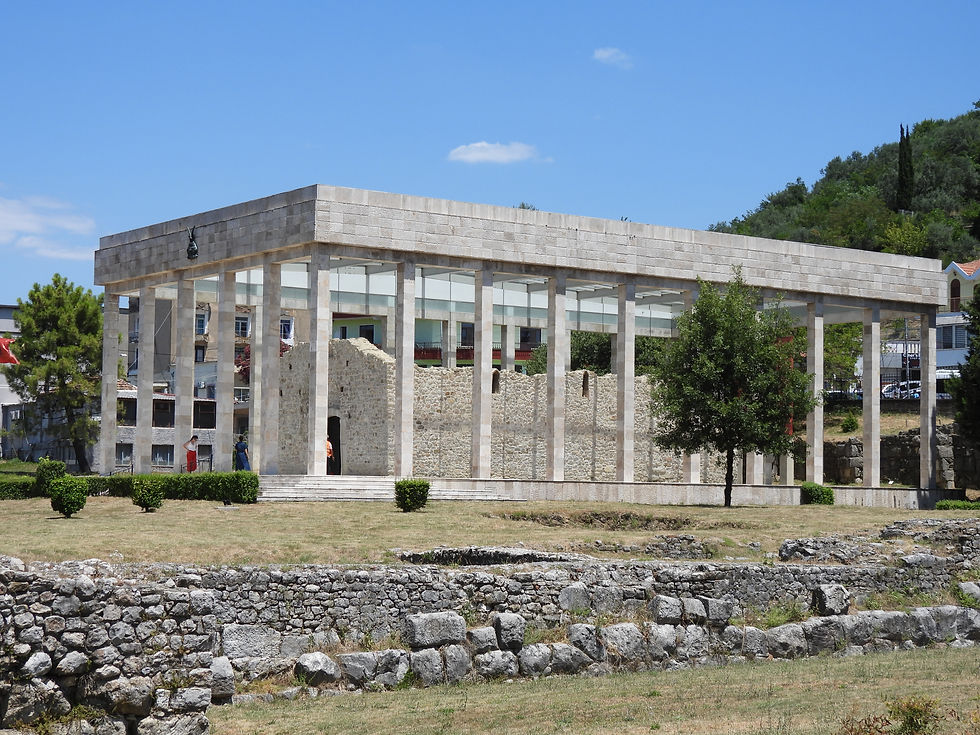
Less than a kilometer up the road was the Skanderbeg Tomb and Museum, an impressive monument to Albania's national hero, Gjergj Kastrioti Skanderbeg. Parthenon-like outer pillars support a grided glass roof over the remains of the Kisha e Shën Kollit / Former Cathedral of St. Nicholas which houses Skanderbeg’s fifteenth century tomb. Located in the middle of a very large field of ruins, Klevis had to drop me outside the restricted area. I headed to the structure, only to be sent back to a ticket booth to collect an admission voucher. The concession waived the 200 lek fee, so I returned to the monument.
Orthodox Church of Lezha Kisha "Metamorfoza e Shpëtimtarit" Archeological ruins at Skanderbag Tomb and Museum, Lezhe Placard in ruins of St Nicholas Cathedral, Lezhe Musuem and nave, ruins of St Nicholas Cathedral, Lezhe Nave and museum, ruins of St Nicholas Cathedral, Lezhe Tomb of Gjergj Skanderbeg, ruins of St Nicholas Cathedral, Lezhe
The cathedral ruins are four stone walls, with a curved apse at the east end. Darkened bronze shields bearing the double-headed eagle are spaced around the north and south walls. In the center of what would be the nave is the tombstone, marked with a sword and helmet.
Exiting, I noted the large Orthodox Church of Lezhe across the Drin River. Back to the car, we continued north, to Nënshatë. The rural road passed through agricultural patches of vineyards and olive trees, dry almost arid landscape. I was looking for the Cathedral of Saint George of Sapa, but Klevis dropped me at the small church on a rise just off the roadway thinking the Church of Archangel Michael was my goal.
Exterior, Church of Archangel Michael, Nënshatë Center bave aisle view, Church of Archangel Michael, Nënshatë Sanctuary and nave, Church of Archangel Michael, Nënshatë Google Maps showing church and cathedral locations, Nënshatë
Unaware of his error, I climbed the hill to the church and took photographs of this Franciscan church. A beautiful modern church with a half-circle footprint, I enjoyed my 20-minute visit, albeit no one was there.

Nearing the end of the journey, we had one last stop in Vau-Dejës. Coming into the town from a rise, the belltower rose above the tree line with the tiled dome alongside. With a near square footprint, the four corners are snipped to an octagon, the Cathedral of Mother Teresa / Katedralja Nënë Terezja opens onto a broad pedestrian plaza. Tri-level, the lower is a shallow-roofed cover to a surrounding porch.
View of cathedral belltower on approach, Vau-Dejës, Albania Statue of St Mother Teresa in front of cathedral, Vau-Dejës Main entrance, Cathedral of Mother Teresa, Vau-Dejës Main altar, Cathedral of Mother Teresa, Vau-Dejës Wall mural, Cathedral of Mother Teresa, Vau-Dejës Balcony view of nave and sanctuary, Cathedral of Mother Teresa, Vau-Dejës
The next level held a gallery; both contain clerestory windows with stained-glass. The front doors were locked, but I found a westside door open. Around the nave were recesses with murals depicting Christian history.
After a quick stop for cash at an ATM in Shkodër, Klevis dropped me at Villa Loredan Hotel where I had room 12. A quiet neighborhood, I did some cursory unpacking for my 3-night stay.

Then out into town on foot, walking about 10 minutes to Katedralja e Shen Shtjefnit Protomartir / Cathedral of St. Stephen Protomartyr. The seat of the Catholic archbishop, the building looks very western from the distance. The exterior is what I call “Papal yellow”, rising about 3-stories with a detached belltower twice as high. Once inside, it felt boxy, with the straight walls of the wide nave rising to a flat coffered vault. No altar rail, a cordon protects the sanctuary, a modern altar table under a suspended crucifix, with the cathedra
Nave with coffered vault, St Stephen Cathedral, Shkodër Nave and side aisle, St Stephen Cathedral, Shkodër Crucifixion station, St Stephen Cathedral, Shkodër High altar in sanctuary, St Stephen Cathedral, Shkodër Rearward view of nave, St Stephen Cathedral, Shkodër Painting depicting 20th century martyrs
back in the apse in front of the high altar and white marble reredos. Interesting oil paintings are on the side aisle walls and in the sanctuary.
Movie cinema, Shkode Ebu Beker Mosque, Shkoder
Exiting out onto the street, I passed the pink cinema as I waked to a laundromat. Determining that they would wash, dry and fold, they closed at 7. Deciding to visit the Orthodox cathedral, I saw another laundromat, which closes at 6 as I walked past the Ebu Beker Mosque. On the next block I came to the Nativity of the Lord Orthodox Cathedral.

With domes at the four corners, a large central dome over the nave, this cathedral replaced a damaged church in 2000. The exterior façade is a dull yellow, with peach insets and white trim. An overhead porch at the top of a set of stairs covers the entry.
Entry into nave, Nativity of the Lord Cathedral,Shkodër Iconostastis, Nativity of the Lord Cathedral,Shkodër View into dome, Nativity of the Lord Cathedral,Shkodër Belltwoer, Nativity of the Lord Cathedral,Shkodër
The iconostasis and cathedra are carved from wood and adorned with icons. Marble pieces tile the floor in geometric patterns. A gallery surrounds the nave floor, with the dome unpainted.
Room 12, Villa Loredan Hotel, Skhoder Bathroom, Villa Loredan Hotel, Shkoder Shkoder street cafe Inferno focaccia in Shkoder Calm before dinner on street in Shkoder
Back to the hotel, I used the WiFi to push individual photos of the cathedrals I’d visited up to the book’s Facebook page. Out for supper, I had “Albanian fast food” – a wrap on focaccia called Inferno. With two glasses of red box wine, all coming to 10€. At 8pm, the many sidewalk eateries were empty, chairs and tables lining the stone block street. The setting sun was just beginning to color the western sky as I headed back to my digs. After backing up the camera, I push through emails and then read until bedtime.
Day 100 Shkodër II
Rising around 8, I had breakfast which consisted of a chocolate croissant and lemon tea. With my soiled clothes in my small roller, I headed for the laundromat Lavanderi Spahija which was open later into the evening. While the clothes would be ready the next morning, I planned on collecting them with the driver I had for Wednesday. Already south of the city center, I continued south to visit the fortress.
Mosque of the Madrasa, Shkoder Public art, monumnet in rotary, Shkoder Rozafa Castle and Fortress, Shkoder
While walking, I’d been aiming to walk in the shade. At an intersection of two main streets into a V, the Mosque of the Madrasa was on my side – an attractive building with a huge minaret in back. A bit further on, a rotary united the bypass road with the main route through the city, and it had a bizarre sculpture within. Then, up to the south on a high hill stood the Rozafa Castle and Fortress. A waiting jitney filled with passengers, and it would be 15 minutes before it returned. I opted to just climb the stone block road, weaving my way around the hill. At the gate, I ponied up the admission fee, and began my explorations through the gateway in the walls.
Map and plan, Rozafa Castle, Shkoder Entry gate, Rozafa Castle, Shkoder Rozafa Castle, Shkoder Wortification walls, Rozafa Castle, Shkoder View over valley, Rozafa Castle, Shkoder
As the road into the ruins rose before me, I witnessed the layers of fortifications looking out to the north. The ground held low walls and foundations of buildings, with knee-high vegetation growing wild. Climbing the walls, I looked down on the Buna River, with the sea off to the left. I felt it was a perfect day to be climbing stone walls. The site was divided into stages, so in Stage 1 I met 3 Aussies, 2 who had graduated from uni, while the third had a year to go. They had been climbing in the nearby mountains, and would be heading to Paris. The student then planned on heading towards Dijon and Orange.
Moving from one series to the next, I then encountered a trio that I thought were German. It turned out they were Belgians from Gent – a couple with their 21yo son. We kept bumping into one another as we paralleled our explorations, always striking up an interesting conversation, sharing observations.

Placards within the site claimed that a cathedral had existed within the walls, and I spent time within the falling walls and taking pictures. Research indicates it may have been the original St Stephen’s Cathedral.
Third stage courtyard, Rozafa Castle Edge of fortifications, Rozafa Castle Water catchment, Rozafa Castle View from inner courtyard, Rozafa Castle
Moving on to stage 3, I met my next trio – a mother traveling with her 28yo son and 21yo daughter, who hailed from Azerbaijan. My phone number was added to their contacts, but I don’t think I’ve heard from them since. Stage 3 included the courtyard and museum as well as a café. It occupies the point of the fortress walls, with stunning views of the river.
Three and a half hours of bright sunlight, I was ready for a break. I strolled down the hill, stopping at a small market for water and a toilet. There had been a taxi there on my way up, so I’d hoped to ride back into town. No luck, so I strolled back to the flats. After an hour, I stopped in a pizza place for a meatball pizza – which had a humorous presentation.
Staked tomato plants near Rozafa Castle Store and cafe, half way on the hill to Rozafa Castle Gate into mosque and reception center, Shkoder Meatball pizza, Shkoder Moslem school, Shkoder
Ever planning, I’d booked a Guruwalk free walking tour for (originally) 4:30, so I headed to the rendezvous point ahead of the new start time of 5. She arrived on time, but because an Italian couple who’d also booked didn’t show, she canceled. She is Muslim, a mother of 3 boys (6,12,15) with a Catholic husband. She shared some good information with me before heading home.
Per her advice, I visited the photography museum, not finding it terribly interesting – many good old photos of Shkodër by the Marubi family. The ones I photo’d were of a ballet performance. I dropped in to St Francis' Church for a few inside shots, then stopped in a pub for a beer. The ale was English, flat and warm, but wet my whistle.
Guruwalk meeting point, Shkoder Marubi photograph of ballet dancers Inner courtyard, Photography Museum, Shkoder Seminary class by Marubi Marubi Exhibition, Photography Museum Church of St Francis, Shkoder Nave view of sanctuary, St Francis Church Pub in Shroder Draft quaff in Shkoder Evening street scene, Shkoder
The neighborhood of Shkodër Gjuhadol was friendly and I got a Puka draft to sip on while checking for my ride to Tirana on Thursday. A nearby hostel would get me there inexpensively but directly. There weren’t too many commercial options, so on my way to the hotel, I walked to the hostel and booked my seat. As I strolled towards my lodgings, the cafés and bars along the streets were full of younger people chilling at the start of the evening.
Back to my room (this lodging was somewhat like a B&B, with a common space that was a sitting area and a kitchen, but locked rooms with baths,) I dropped the camera off. And I took no notes or pictures for the rest of the evening.
Day 101 Shkodër III – Montenegro
Maksiljan was my daytrip.com driver and he was a half hour delayed in collecting me because of traffic. Leaving Shkodër in an Audi, we headed north into Montenegro. Fifteen minutes to cross the border (back into Schengen Zone) and then off to the town of Vladimir.

We were looking for ruins, and we had to do a bit of hunting to find the archeological site. Finally, after parking the car, we climbed a slight hill and then over a stone wall into a field of thigh-high weeds. The former Cathedral of St Vladimir / Katedrala sv. Ivana Krstitelj was deep across the fields, its front and back walls more visible. With Maks, we both clambered into the former nave, marveling at what we could see, albeit no markings or placards. This was new for him, and he was gracious to have it added to his repertoire.
Approaching the ruins of St Vladimir's Cathedral Through the portal at ruins of St Vladimir's Cathedral Field of brambles next to ruins of St Vladimir's Cathedral Field of brambles next to ruins of St Vladimir's Cathedral
Back to the car, we spent a minute picking off the hitchhikers that the brambles had gifted us. Our next stop was coastal, in Ulcinj. He drove into the historic center of town and dropped me off as parking was impossible.

I walked to the fortress/museum gate and paid my admission fee, stepping into history. The former Cathedral of St Mary / Katedrala sv. Marije was right inside the gate, a small stone building with a single doorway visible. What I initially took for a smoke stack turned out to be the remains of the belltower.
Museum display of cannonballs Archeological ruins of Ulcinj Fortress View of Adriatic coast in Ulcinj, Montenegro Museum in former St Mary's Cathedral, Ulcinj
Cimbing the steps to enter the ex-church, I found I was entering the museum. Small, with display cases on the long walls, I would label my visit cursory. Retreating to get more shots of the exterior, I then surveyed some of the weed filled courtyard grounds, similar to what I’d seen the day before. And the views from the parapet were spectacular.
The next destination was in the port city of Bar. I’d actually hoped to take the ferry from Bar to Italy at the end of my Albanian leg, but the ferry had a difficult schedule to decipher, and I opted to sail from much further south. Maks chose to visit the ruins in Stari-Bar first, a small village in a ravine.
Base of vally, looking at a buiding ruins Ruins just turn out to be an abandoned building Mural on building wall depicting cathedral and tower
A challenge to find, we tried the lower levels near the river, and then the heights. On the heights, another fortress-like complex of ruins spilled out in front of me. I poked around for nearly an hour, frustrated by lack of maps and signage, and was about to give up trying to find the former Cathedral of St George when I chanced on it – a flat space with barely a footprint outline at the very point of the highgrounds.

Fortunately, there was a placard in Albanian, English and Russian validating that this was the former cathedral.
Entering the Citadel Tatarovica seeking dathedral ruins Ruins on hilltop Citadel Tatarovica Reminants of Monastery of St Nicholas, Bar Pint on hilltop where cathedral ruins lie
We crossed outside to a small open-air café and I had a quick bite of cevapi at Çardak Konoba.
Menu cover, Konoba Cardak, Stari-Bar Cevapi and fries, Konoba, Stari-Bar
Then back in the car, we stuck to the hills and arrived at the Cathedral of the Immaculate Conception of the Blessed Virgin Mary / Katedrala Bezgrešnog Začeća / Катедрала Безгрешног Зачећа Блажене Дјевице Марије.

The local Catholic cathedral, it sat behind a wall and gate, its separate belltower to its south. I climbed the wall and walked to the door, and then went around the building.
Fifteen minutes later we had arrived a busy corner just outside of Bar’s center, in front of another closed gate, with the Co-cathedral of the Apostle St Peter / Konkatedrala Svetog Petra Apostola. Dual flanking towers at the entrance, the color palette is blue-gray with brick red accents.

The gate was open, so after getting out into the field to the south for pictures up the hill, I went to check the entry doors. Open, but access was limited to the narthex. From there, the nave was full of natural light, cream walls and an oxblood marble floor with light wood pews. The backwall of the sanctuary was wood with the bishop’s throne at its center and one step higher that the other armchair seats.
Front doors, St Peter's Co-cathedral, Bar Nave, St Peter's Co-cathedral, Bar Sanctuary and cathedra, St Peter's Co-cathedral, Bar Casting on entry door, St Peter's Co-cathedral, Bar
After a stop at an ATM to collect euros for the next stage of my trip, we headed to the Orthodox Cathedral of St. Jovan Vladimir / Саборни храм Св. Јована Владимира.

Formidable, the simple white of the exterior façade, embellished with gold crosses and domes, the church fills the north half of a block in central Bar. Once inside, the illustrations of the many icons in murals on every surface almost overwhelmed. Heavy use of a sky-blue shade serves as the background to the holy images. Entry into the nave was cordoned off, limiting my angles, but still I was quite enthused with this visit.
Interior of dome, Cathedral of St. Jovan, Bar Narthex entry into nave, Cathedral of St. Jovan, Bat Iconostasis, murals in sanctuary, Cathedral of St. Jovan, Bar Icon murals in arm, Cathedral of St. Jovan, Bar Cathedra and wall icon murals, Cathedral of St. Jovan, Bar
By the time I exited the Orthodox Cathedral, it was 3:30. One cathedral remained on my list, the former Cathedral of St John in Budva, which I’d missed on the cruise excursion during the April port stop in Kotor. The round trip would take about 2½hours, plus however much time I needed at the site. Traffic would build from 4pm, creating delays at the border, particularly if the border computer system actually came online. So I decided to forego Budva and head back to Shkodër. The border crossing took more than a half hour, and we were able to stop and collect my laundry as we passed into the city.
A rather successful day, I sat in the common room and pushed my phone’s photos of the six cathedrals we’d seen up to Facebook. Having determined that the dining hour was more like in Western Europe, I headed out about 8 and got a table at the Hotel Lodi restaurant.
Cassar salad at Hotel Lodi Linguine Karkalec Kungull at Hotel Lodi Bustling evening street activity in Shkoder
The Caesar salad was an original approach, shavings of parmesan over arugula with tomatoes and balsamic vinegar. Linguine Karkalec Kungull (shrimp, pumpkin, tomato, sauce) was a fail due to the mushy shrimp. I took two shots of the street after I finished dinner. After backing up my photos, journaling my day, and packing up, I set my alarm and went to sleep.
Day 102 Tiranë
After tea and a cream-filled croissant, I wheeled my gear to the hostel. I’d misplaced my ticket, and after a minor paperwork shuffle (they had me down for the next day), I joined 27 others heading south. At a point along the route, the 2 vans pulled off and separated those going to the airport from those, like me, going into Tiranë. And here was where the screwup occurred – my small roller was moved into the airport-bound van, which I discovered when I was delivered to the hostel in Tiranë.
Anxious and pissed, I would have to return to collect my bag. They confirmed that the driver had my bag, and promised it would be onsite at 7pm. With the Nikon in that bag, I felt like half a person. Very, very unhappy, at 11am I left, rolling the big case to the Golden City Hotel, a half hour journey. Arriving early, they advised the room would be ready in 5 minutes, so I stood and paced and then sat for 30 minutes until I got the key to the room. One flight of curved marble stairs, and down to the very end of the hall to the tiniest room I’d been in yet. I noted that it was a good thing I hadn’t planned on going into the big bag. Albeit, I didn’t have the small one.
Room in Golden City Hotel, Tirana Room bathroom in Golden City Hotel, Tirana
Back to reception, I learned that the tap water wasn’t potable, so headed out to find a market and purchased 2 2-liter bottles. The room frig was so small, I had to remove the shelves to hold them. There are 2 cathedrals in Tiranë, so I set off to find them. First up at just over a half kilometer away was the Orthodox Cathedral of Resurrection / Katedralja Ortodokse Ngjallja e Krishtit. With its separate modern belltower and dome-like front façade, I initially thought it was a mosque, until I saw the cross over the front doors.

The cathedral sits in the middle of a block filled with governmental buildings. Facing west, the footprint is circular, and is reached by three sets of stairs (5, 4 and 9) from the surrounding stone-paved plaza. It as a gift from the European nations to Albania, as Hoxha had had all churches torn down.
Entry, Resurrection Cathedral, Tiranë Sanctuary, Resurrection Cathedral, Tiranë Half of the iconostasis, Resurrection Cathedral, Tiranë
Completed in 2012, the nave is filled with individual wood chairs. The illustrations in the spandrels seem preliminary, as if the icon murals will be added later. Bright with natural light, the high vault of the dome contains the Pantocrator image. Both the frame for the iconostasis and the archbishop’s throne are carved white marble.

Less than 10 minutes away, crossing diagonally through a park, is Saint Paul's Cathedral / Katedralja Katolike Shën Pali. A gift from the United States, it was inaugurated in 2002. The cream-colored modern building faces due south practically facing the Pyramid of Tirana, a landmark. The footprint is symbolic, combining a triangle (Trinity) with a circle (eternity). I couldn’t help but think that the stained-glass window over the entry looked phallic.
Wedding pictures at the altar, St Paul's Cathedral, Tirana Side view of sanctuary, St Paul's Cathedral, Tirana Rear of nave, St Paul's Cathedral, Tirana View from side altar of nave, St Paul's Cathedral, Tirana
It was Thursday just after one in the afternoon, and a small wedding had just obviously concluded, as the photographer was getting his shots. Ten minutes later the nave was empty, and I began my rounds. The pews are curved, facing the altar table. A plain curving wall backs the sanctuary, with the cathedra centered on the wall below a wooden crucifix. The tabernacle with the presence stood below three arches in the front corner of the nave. Opposite was a statue of Mary, Queen of Heaven. Behind the sanctuary wall, a small chapel filled the apex of the triangle. A narrow gallery encircles the nave seating.
While walking to the cathedrals I reflected on my previous camera losses, and decided to return early to the hostel. When I got there, I politely asked for the name of the driver, identifying information for the vehicle and the hostel organization. Asked why, I advised that if I had to file an insurance claim, I would need to file a police report in situ. I suspect mentioning the police triggered anxiety, and I was assured that a report would be unnecessary. My visit prompted her to get a photo of the bag to attempt to reassure me.

Leaving, I wandered the area. I was surprised to encounter the “Franciscan Cathedral”, on Ali Pashë Gucia St., another modern building with a 10-story tall belltower with a large cross on top. Behind locked fencing, the architectural style jarred with the surrounding neighborhood. While I couldn’t visit, the Internet notes indicate the walls are filled with memorials to Franciscans murdered during the communist regime. As a church without a bishop and within the archdiocese of Tirana and Durrës, it really isn’t a cathedral.
With a Guruwalk tour at 5pm, I still had a few hours before heading to the Opera House rendezvous point. Strolling the streets, I took a few pictures (many fewer than I would if I had the Nikon), spotting some very modern and striking buildings.
Street art: building mural, Tirana Interesting architecture, Tirana Plaza and Interesting architecture, Tirana
Reaching Skanderbeg Square, I found an Irish bar within sight of the Opera House and entered. With only Carlsberg on tap, I was disappointed but had one while munching on peanuts. I spoke with a Brit who came in, and pushed cathedral pictures up to Facebook.
A group of about 20 gathered for the guide, Ray, a 20yo. Other than me, the oldest might have been 40; the group included Germans, Australians, French, English and Brazilian. Ray had lots of good information, exuded energy and enthusiasm, and kept us to a decent pace. We walked around the Pyramid, encountered numerous bunkers, and heard tales of post-Iron Curtain life. We never entered a building, allowing us to decide to return on our own. This was an excellent tour.
Monument, stop on Guruwalk tour of Tiranë Public art, building mural, stop on Guruwalk tour of Tiranë Interesting paint job, stop on Guruwalk tour of Tiranë Plaza with bunker, stop on Guruwalk tour of Tiranë Plaza, stop on Guruwalk tour of Tiranë Intersting architecture, stop on Guruwalk tour of Tiranë Street art, mural on wall, stop on Guruwalk tour of Tiranë Park with free WiFi, stop on Guruwalk tour of Tiranë Pyramid, stop on Guruwalk tour of Tiranë Public art, bas relief sculpture, stop on Guruwalk tour of Tiranë Bunker in sidewalk, stop on Guruwalk tour of Tiranë Another interesting bulding, stop on Guruwalk tour of Tiranë
Ending just about 7, I dashed back to the hostel. Profuse apologies were offered; the bag was turned over. I felt they were useless, truly lacking any sense of customer service. Had I controlled the situation, I would have made sure the bag was delivered to the hotel, relieving me of having to make extra trips.
Rolling back to the hotel, I got my dental appliance out to dry and went out in search of dinner. Nothing in the immediate vicinity appeals (please, no more pizza), so I went down a perpendicular street to In’s Arena. Starting with the house salad, it included fennel, which I thought gave it a great punch in flavor. The winter squash soup was hot but bland, with ginger, orange and shrimp; it needed a lot of salt and pepper. My main was a flatbread offering, rolls of sliced turkey on top of a white cream sauce, sprinkled with ground pistachio all on large toasted flatbread.
House salad at In's Arean Restaurant Winter squash soup, at In's Arean Restaurant Toasted flatbread with turkey, at In's Arean Restaurant
On returning to my room, I discovered that the AC and refrigerator don’t work unless the room card was engaged in the slot by the door. Had I known, I might have tried a business card, that usually works.
Day 103 to Durrës ferry
With daytrip.com sending a car and driver at 7, the alarm had me up at 6, in the lobby at 6:40 and picked up 10 minutes later. Klodjan and I had five cathedrals for us to see before he would send me off on the Adria Ferry to Italy at the 2:30pm check-in time. We set off for Berat, nearly 100km south.
On reaching the Berat Castle, I learned that the hilltop was mostly museum, with the Cathedral of Dormition of St. Mary enclosed inside the fortress walls.

The Onufri Museum wouldn’t open until 9, a 30-minute wait, and we were on a tight schedule. So I got a picture of the belltower behind the fortress wall, and a placard describing the cathedral, and we headed into Berat proper, to the other end of the city. There, the Saint Demetrius Orthodox Cathedral / Katedralja e Shën Dhimitrit stood on a plaza at the foot of a hill.

Twin towers anchored the northwest facing front, with a large central lantern dome over the square building’s crossing. An Orthodox cathedral, it was built in 2002 over the destroyed previous cathedral. Entering the nave, I encountered two priests presiding over the Divine Liturgy. The walls and vault are white and unadorned; the iconostasis carved of wood. Respectfully, I exited, looking out at the hill with the Assumption Cathedral taunting me from the cathedral plaza.
Divine Liturgy underway, St Demetrious Cathedral, Berat Information placard, St Demetrious Cathedral, Berat From the plaza, Berat Fortress in the distance
Back to the car, Klodjan again offered to return to the Fortress, but I asked him to push on as we headed to Vlora on the coast. Well to our southwest, we had to return north to the pass near Karbunarë. Total distance would be just over 100km. The Kisha Shën Luigji Gonzaga e Shën Maria / Church of St. Aloysius Gonzaga and St. Mary is a pro-cathedral, seemingly just a parish church temporarily the seat of the bishop.

Not in the best of neighborhoods, I took a dozen photographs inside after getting a few of the church’s front. On the edges of the city, we didn’t have to deal with city traffic as we turned and headed north to Fier.
Nave of the Vlora pro-cathedral Sanctuary of the Vlora pro-cathedral Nave from altar, Vlora pro-cathedral Painting of patron saint, Vlora pro-cathedral
Perhaps because I’d been separated from my camera the day before, I was taking fewer than usual pictures. None of the journey, which later surprised me. As we entered Fier, we approached from the east, heading to the Lumi I Gjanices, the Gjanica River flowing through the center of the city. A few blocks off, Saint George Orthodox Cathedral / Katedralja Ortodokse "Shën Gjergji" faced west.

Built from 1997 to 2007, the design aimed to replicate the previous basilica-style building. A 30m belltower over the front entrance, with a dome over the crossing behind it on the roofline, the orange tiled roof blended with the pale peach of the outer facade’s walls. Olive trees filled the grass stretch between the driveway and the riverfront street, making front-on pictures difficult.
Nave and iconostasis, St George Cathedral, Fier Half-dome over sanctuary, St George Cathedral, Fier Nave and galleries, St George Cathedral, Fier Floor mosaic, St George Cathedral, Fier
Similar to Saint Demetrius Cathedral earlier in the day, the interior nave walls and vault are unadorned. Individual chairs fill the floor space, facing a wooden iconostasis. Behind this, the apse of the sanctuary does have murals painted in the traditional style. The floor in front has an inlaid mosaic of shades from cream through charcoal forming a circle.
Approaching noon, we set off for Durrës, about an hour and 80km to the north. Once we reached the very sprawling city of Durrës, we navigated through traffic to the port.

Spotting the Albanian Orthodox Cathedral of St. Paul and St. Asteios in a fenced in park at the end of a block and facing the marina, Kledjan let me out to get pictures while he sought parking. The park was beautifully landscaped, shade trees near benches. With a portico wrapped around the southwestern sides, the creamed-colored building was trimmed in brown, roof surfaces covered in tiles. The lantern dome and the belltower to the north completed a classic presentation.
Information placard, Sts Paul & Asti Cathedral, Durrës Nave and iconostasis, Sts Paul & Asti Cathedral, Durrës Apse dome mural, Sts Paul & Asti Cathedral, Durrës
Again, as with the two other Orthodox cathedrals that day, the interior was barely decorated. The iconostasis was carved wood, simpler than many I’ve seen. The Mother and Child mural in the apse seemed smaller than in Fier. I did find the episcopal throne.
On my way to rendezvous with the car, I spotted a sign pointing to a co-cathedral. I’d not noted a Catholic presence in Durrës, so I wended my way around a few narrow streets and corners. A small stone-faced building with four half-columns melded into the front façade, windows were placed high in the walls. The signage placards out front declared it to be St Lucy’s Co-Cathedral / Kisha e Shën Luçisë. Unfortunately locked, I felt blessed as I had an extra visit to count that day.


Finding Kledjan and the car, we had time to eat before heading to the ferry terminal. And, he advised me, he urgently needed to find a charging station, as the car was close to “empty.” Power station was the priority, so after finding a compatible one, he negotiated a charge and we crossed the street to the restaurant. Truly a heavy carnivore meal, the grilled meat platter came out with lamb chops, chicken filets, beef steaks and cevapi along with a tomato and cucumber salad and fries. We ate what we could, and he took the remainder home for supper.
With a nearly completely charged Honda, we headed to the ferry terminal. After tipping him, Kledjan headed home and I crossed over to board the ship, moving my bags to my cabin at the bow of the ship. Two narrow twins, a couch, desk and sloped ceiling, I would be okay for the Adriatic crossing aboard the Adria Mia.
Beds in cabin aboard ferry Entry door in cabin aboard ferry Bathroom in cabin aboard ferry Ferry customer services desk View of port of Durres View of port of Durres Upper deck and pool on ferry Upper deck on ferry Upper deck food service bar Main bar on ferry Bar lounge on ferry Seating lounge on ferry
From 4 until the ship left the port at 5, I wandered with my camera in hand, snapping pictures both inside and out. An hour underway, I slipped into a booth at the bar with my journal and wrote up my day, sipping on a Kronenbourg, the only beer available. Fortunately, I had my own nibbles, as the bar only took euros, and the beers were 6€ each. By 6:15, mobile service ceased, and the onboard WiFi didn’t give me Internet. Dinner was served at 7, and I had penne bolognaise and a Greek salad. Water aboard wasn’t potable, so I was glad I had 2 liters left. The sun set at 9 and I was horizontal at 10.
Mediterranean salad aboard ferry Penne bolognaise aboard ferry Sunset shot from cabin window aboard ferry

You can purchase your own copy
(or have me send it as a gift) of
Cathedrals to the Glory of God
by clicking this link:
Volume II has been released

You can order your personal copy
(Print on Demand)
Cathedrals to the Glory of God
Volume II
by clicking this link:


Comments