A Week in Romania: part 2 - Cluj-Napoca, Brasov, Bucharest
- KB Cook

- Nov 14, 2025
- 16 min read
Day 47 Cluj-Napoca
Five minutes of low-pressure tepid water before I would take a hot shower, spray bouncing onto the sink. The mattress had been hard and uncomfortable, and the room had been cold throughout the night, despite my attempts to adjust the heating. Once I had hauled the large bag downstairs, Janos, my driver for the day, arrived and helped loading it into the Passat.

Once I checked out, we headed to downtown, where I was able to get outside shots of the ex-cathedral Church of St Ladislaus, thus completing Oradea on my list. Significant wooden scaffolding, at the main entry, plus traditional pipe scaffolding and canvas cover the sides. No way was anyone getting inside without a hardhat.
Leaving Oradea, we headed east, paralleling the Hungarian (Debrecen) and Ukrainian borders (100km north) for about 240km. Our initial objective was Gheria. Close to the center of this town is Holy Trinity Cathedral / Catedrala Armeano Catolică which was first on my list for the day. Surrounded by trees, the silver-topped towers rose over a light gray roof and white walls.

Facing northeast in Parcul Mic, an easy shot was not to be had. When I went to the entry, statues of saints guarded the wooden double-doors, which showed wear. Through those doors, I stood in the narthex, dirty glass in a wall preventing me from entering the nave. I managed a few shots down aisles, and left to walk around the building in hopes of an open door. It was not to happen, but I did get more exterior shots with mature trees providing (unwanted) coverage.


While it is a small town, passing through Gheria was charming, but midday traffic was tough. About 35-40km to the south west, we arrived in Cluj-Napoca. Once past the suburbs, the city looked good as we passed one cathedral. After dropping me at Vila Siago, Janos took off and I got registered and took care of the immediate needs before heading out into town.

Down a hill to an artery, then two blocks to the right, to reach the Transfiguration Greek-Catholic Cathedral / Catedrala Greco-Catolică „Schimbarea la Faţă”. On a corner and facing north, the bright yellow-orange with white columns shown under the partially cloudy skies. As I was becoming used to experience, the blend of orthodox and Western was evident.


Pews filled the nave on either side of a carpeted center aisle, leading to a single-level iconostasis. The stenciled vault was a charcoal gray, while the walls of the nave were light gray and white. Behind the door of the screen, the apse wall was pink, white columns framing an image of the Transfiguration.
Down the boulevard about a quarter kilometer and then left, I came to the huge "Dormition of the Mother of God" Metropolitan Orthodox Cathedral. Occupying the north end of Parcul Avram Iancu, it faces south past statues of a bishop and a metropolitan to a large fountain.

The predominantly off-white building has slate black trim and domes. Narrow slices of windows dot the sides. While the domes rise well above the mature trees which surround it, it commands the attention of the skyline. Entering, pipe scaffolding has been erected in the central space under the large dome. The iconostasis appears silver, and a trio of wooden chairs face each other across the sanctuary.


Deep shadows reveal hints of murals of icons of the saints. I felt that there were Moorish elements to the carvings over the arches. The central dome shows the 12 Apostles around a blue circle, where the Paraclete is the only emblem present.
As I headed to the next cathedral on my list, I came across an open-air market. Vendors were offering crafts and art from tables under shading coverings. On one side of that square is the Opera Theater, another the Court of Appeals. Continuing, I had to pass through a verdant park, before reaching a work-in-process. The under-construction Catedrala „Martirilor şi Mărturisitorilor sec. XX / Greek-Catholic Cathedral of the Martyrs and Confessors of the 20th Century will be an impressive structure.

The entrance will face north to a parking lot, while the rest will be surround by streets. The smaller belltowers rise to the east and west of the incomplete central dome, and arched scaffolding surrounds the exterior walls. A set of stairs leads down to a chapel of St Joseph, but these lower doors were locked. Signs seem to indicate construction had begun 30 years previously.
Passing by the old stone city defensive walls and castle remnants, I walked through empty pedestrian streets with closed shops lining the stone pavement. A clothing store proffered bargains, so I bought a polo shirt. As I was heading back towards my hotel, I had one more stop – the Roman Catholic church of St Michael in Cluj-Napoca. Dating back to the mid fifteenth century, it’s had a checkered history, with various sects claiming it until it was returned to the Roman Catholics. Never actually a cathedral, it is still the second largest Catholic church in Transylvania, after Brasov, and locals call it a cathedral.


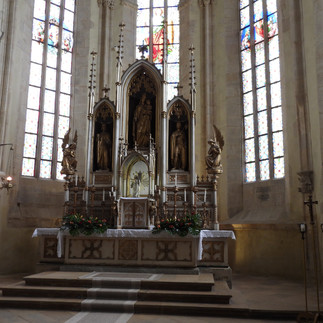


Still, the outsides and the insides of the church are beautiful. I found what appears to be a cathedra cordoned off to one side of the sanctuary near the altar. (Opposite are seats for the celebrant.) Without significant ornamentation, the soaring white columns merge into a lattice of ribs in the vault. Patches of old murals are on the walls, and there is a copy of the Shroud of Turin (a bucket item for this trip) under a relief of the descent from the cross.




Strolling the stone streets, I began wending my way up the hill towards the hotel. Once in the room and on wifi, I updated the Facebook page for Cathedrals to the Glory of God with pictures of the 5 cathedrals I’d seen. After putting a shot of my haircut on my own page, I checked some email before heading out to dinner. Since it was my youngest brother’s birthday, I made sure to send him best wishes. At Alle Bollicine Vino & Pasta there was no English menu, so I worked with the maître d’ to choose a feast. The starter was thin slices of prosciutto, covered in a garlic sauce and topped with figs.



The main was a thick piece of beef, placed in a bed of garlic mashed potatoes. I’d been journaling while at the restaurant, notes raving about the starter and the steak, plus the red wine from Puglia.
Day 48 Brașov
Once I’d finished getting ready to leave, having awaken with the alarm, I clicked for a ride to the train station through Bolt (like Uber and Lyft, but in Europe.) Picked up at 7:25 and a 10-minute ride to the station. I’d hoped for an open food concession, but the waiting room was bare, and nothing was nearby. The train arrived at 8 and we left 15 minutes later heading south; the eastbound train apparently had priority, as we were held in the yard.




This was a 7-hour ride for me, roughly 300km! The train's final destination was Bucharest, and we only made one more stop in Teius 2½ hours along before my stop in Brașov. Rolling green hills, agriculture, forests were visible out the window. At noon I found the snack car and had a freshly made panini, a bag of chips and two small bottles of rosé. By 2pm, the hills had leveled, and there was a river alongside. Once the internet stuff was done, I read on my reader or watched the countryside.


On arriving in Brașov at 3:15, once I figured out the station’s tunnels, I had an easy kilometer walk to Pensiunea Leo. With registering and paying done, I had the key to room 7 after making noise about hefting my bag up two flights of stairs. With the smaller room 7, I only had to go up one. After basic setup, I was ready to go find the only cathedral on my list. Maps indicated 2.8km and ¾ of an hour walking.
The walk took me through residential districts, which triggered no interest with the camera. A large park and garden gave me respite to sit in the shade and watch people. Once I reached the commercial district, the well-kept streets lined with shops had a steady flow of folks.




Approaching Piata Sfatului where the town hall was, crowds were milling and strolling through perhaps a hundred tents, an open-air fair seemingly underway. Weaving my way through, little caught my attention.
“The Black Church” / Biserica Neagră is Evangelical Lutheran, formerly Catholic and then known as St Mary’s. My initial research said it was formerly a cathedral, but within its confines I could find nothing to confirm. [There may be a good explanation: with the end of Communism, churches which had been confiscated were being returned to “original” owners. By not acknowledging prior history, the Catholic Church wouldn’t have a claim.]

The tall, dark-stone church glowed in the late afternoon sun. Crossing the street, I attempted to fit the base and the steeple into the same frame while keeping an eye out for vehicles and pedestrians.
Heading inside and paying a small fee, the results of restoration work was very evident. Point work on carvings, gleaming stones in the walls, columns and vault, polished woodwork: it all looked like a museum. Murals had been cleaned, ornamentation regilded, Ottoman rugs cleaned. All the time I was inside, an organist was playing their instrument.


Information signage was in German, tracing history from the first church built in 1336. [I do read German, and skimming, I didn’t detect the words “Dom” or “Kathedrale”.] With 90 pictures taken over 40 minutes, I’ll share many of them here. However the Wikipedia article definitely considers it a Lutheran cathedral.
Outside, I took more shots of the front and now shaded south façade. A young tourist couple from Turkey struck up a conversation, and I took a few pictures which I later emailed them.


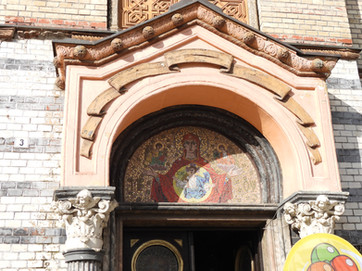
Moving around to the east end of the church, I came back into the square and the fair which was underway. I spotted an Orthodox church off the square, and walked the covered alley to the actual entrance. Dedicated to the Assumption, the "Dormition of the Mother of God" Church / Biserica "Adormirea Maicii Domnului" was a lovely respite from the overwhelming feelings invoked by the Lutheran cathedral.




Heading back towards the hotel, I recognized that I should have dinner “downtown” as I’d not seen much near the hotel or train station. Old Shanghai Restaurant was open early (6:30pm) and I decided on Chinese. With a glass of rosé, I enjoyed Szechuan chicken and vegetable fried rice. Rather than walk, I opted for another Bolt ride.


After backing up my photos and messing around on the Internet, I pulled out my journal. I noted that the room was cold with a non-working radiator. (At least I couldn’t figure it out.) The curtains weren’t blackout, but with a 9am train to Bucharest, no breakfast at the inn, and a 20-minute walk to the station, I figured to take my chances.
Day 49 Bucharest 1
Waiting in the Brașov station, the train was delayed by 5 minutes. Then they added 3 cars, one of which held my reserved seat. Once it got underway, I wound up chatting with a couple from Wisconsin opposite. They were sightseeing, traveling with their daughter and the daughter’s dog. The daughter teaches mathematics and science at an English-language school in Bucharest. The car was relatively empty until about an hour out, and filled by the time we reached the terminus.
The train ride was 2½ hours and arrived at Bucharest North 20 minutes behind schedule. My lodgings were the Bucharest Downtown Inn Hotel, which was about a kilometer away, the start being a walk along a nice city park. At the hotel, it was up a flight of stairs to reception, and then up another flight to room 202. With two twin beds and plenty of floor space, I’d still be either hanging off the end or banging my head. Not a lot of shelf space in the loo, and a small cubicle (with a curtain) for a shower.


With 4 cathedrals on my list, it being a Sunday, I took my time. Leaving at 1:30, I headed first to the Roman Catholic cathedral. Pleasant residential neighborhood with homes and apartment complexes, the kilometer passed quickly in pleasant weather.


Mass was just concluding at Saint Joseph Cathedral / Catedrala Sfântul Iosif; it is red brick and faces north into the T-intersection. Three aisles, the walls of the nave, including above the columns, were covered in stencils of pastel earth tones. The peaked wood-beamed vault, continued over the side aisles, was filled with similarly colored and gilded rectangular boxes. Coffering rose over the two side altars.

Statues of familiar saints line the side walls, between the Stations. Hanging overhead from the arches, banners on white cloth depicted the Martyrs of the Twentieth Century.


In the apse, murals filled an arch on the curved wall, depicting scenes from the life of the patron saint. However, above the tabernacle is a small statue of John the Baptist. At the other end of the central aisle, the organ pipes in the loft blocked a full view of the rose window.
Heading south, I walked almost 3 kilometers through Bucharest. Over that hour, I took note of interesting buildings, intriguing street art, impressive monuments and statues, and pedestrian streets full of people. [Melange of pictures taken on walk in Bucharest.]


The route took me along the Dāmbovita River, at least the portion not built over. Arriving at the Patriarchal Cathedral of Saints Constantine and Helen / Catedrala Patriarhală din București, it sits atop The Hill of Joy. Glistening white, four domed towers rise from the roof. Facing west, the building is north of Palace of the Patriarchate, a large museum.

Coming at the cathedral from the apse’s curved rear, I walked around to the entrance. Seven arches, the center three full height, give way to a covered porch and the entrance into the narthex. On the porch walls, fading murals cover the walls and ceiling; a narrow door between the scene of the last Judgement gives access into the nave.


Inside, saints and patriarchs fill the lower walls, while above are scenes from the life of Christ. The nave is dark, with lighting focused on the brilliant gold iconostasis. This is the former main (or metropolitan) cathedral of the Romanian Orthodox Church.
Before I plotted my next goal, I stopped in at the small chapel in back of the cathedral. Through the open door, I observed a wedding was underway.



Walking west, I passed the Church of St Nicholas, and then the huge Parliamentary Building. Eventually, ahead rose a towering gold dome behind a concrete and stone barrier. With work still being done, the People’s Salvation Cathedral / Catedrala Mantuirii Neamului / Catedrala Națională - Catedrala Mântuirii Neamului gleamed in the sunlight. Consecrated in November 2018, it is the national cathedral of Romania. I suggest reading the Wikipedia page, as its sheer size merits including it in the top 10 church buildings in the world.
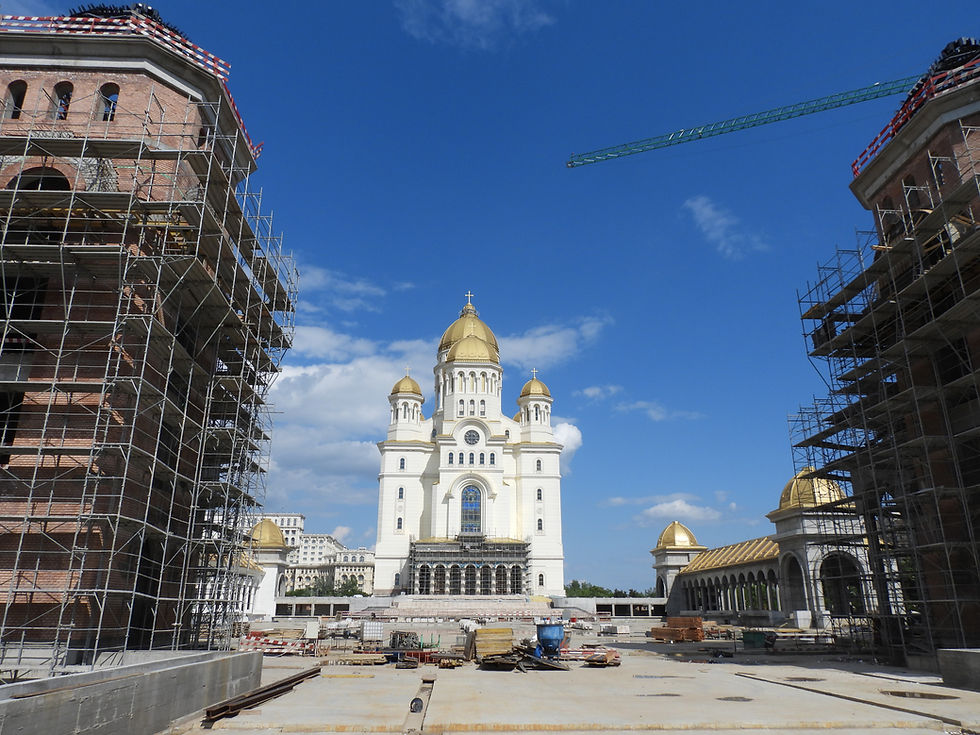
With netting, fencing and walls, the building was not approachable. Google Maps says it’s permanently closed. Go figure. Opposite the construction is the Marriott. I did visit a small chapel nearby, the Saint John Chrysostom Church, which had a revered chair for the Constantinople Patriarch.


Frustrated, I put my final Bucharest cathedral into the phone. It came back with 4 kilometers and an hours walk. I clicked for a Bolt car, and was there in 15 minutes

On Strada Polanā and set way back down a narrow alley of trees, the Saint Basil the Great Cathedral / Catedrala Greco-Catolică Sf. Vasile cel Mare is a modestly-sized red brick structure. Maps had said it would close in 15 minutes, but with its small space, getting photos wasn’t a challenge. Stepping outside for more external shots, the bishop drove up to celebrate Mass, and invited me to stay. A new experience, I sat quietly and observed.


A bonus was sprung on me, when, at the end, he introduced a choir which performed a Sacred Music concert for 45 minutes. By the time it was over, I was hungry.

Maybe 40% of the walk back to the hotel, at the Piata Romana rotary, I stopped at Bossman's Burger Factory Romana. Dinner was Cheese My Soul, with a chicken filet and a bottle of Tuborg, as there was no beer on tap. A stacked burger, a steak knife held it together, as the fries had been pushed into the top bun. Unfortunately, the fries were cold, but I skipped them and much of the bun.
Back in the room, I was writing in my journal at 10:30pm. I’d heard from Razvan, my ToursByLocals guide, and I’d be getting picked up at 9 in the morning.
Day 50 Bucharest 2
My morning started well – hot shower with good pressure – and breakfast of fried eggs, Canadian bacon, cheese, toast with juice and coffee. Razvan was on time for his tour of Bucharest (car-based). When setting an itinerary with him during my planning phase, I’d included the 4 cathedrals as “must see”, so when I explained I’d walked to them all the day before, he began to improvise. (I figured I had a day of seeing “tourist stuff”.) From my notes written over dinner that evening, there was “too much for me to remember without looking at (my) photos.” And I neglected to write him an email to ask if he might better remember what all we had seen.


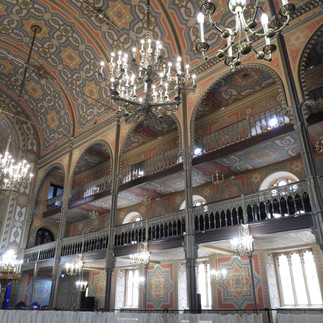
After passing the Romanian Athenaeum and the Interior Ministry building, we stopped at the Choral Temple, an Orthodox Jewish synagogue built in the Moorish Revival style with red and yellow bricks. Entering, I noted the center aisle curtain, used to “separate” males and females despite the presence of two levels of galleries which typically served that purpose. All the ceilings were stenciled in a repeating pattern of orange and sand on a blue-gray field.

Driving to the Salvation Cathedral, Razvan directed me to a much better venue for getting a good photo. Crossing to the other side of the Parliament Building, he parked near Constitution Square. We stopped at Haute Pepper for lunch, where I had the Gnocchi Quattro Formaggi al Forno with Asparagus with a glass of Fildirose Pinot Grigio Rosé.



In the Carol I Parc, the Tomb of the Unknown Soldier / Mormântul Ostașului Necunoscut rose into the sky from the small hill where it stands. We’d passed a turreted castle-like building, which appropriately was the National Office for the Cult of Heroes / Oficiul Național pentru Cultul Eroilor.


Heading back towards the Opera House, Razvan took me to the New Saint Eleutherius Church and its older building. Considered to be one of the more beautiful of the Orthodox churches in Bucharest, the red-and-white horizontal stripes on the exterior, plus the 3 horizontal bar cross on the central lantern tower intrigued me. Unfortunately, only the narthex was open.

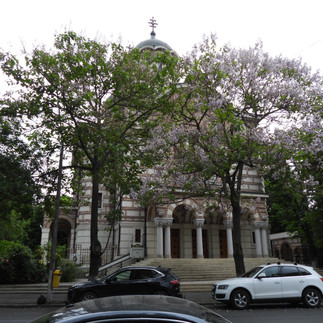


Heading north, we drove in the proscribed loop by the Ceauşescu Residence. Reportedly, tunnels connected the building to many of the governmental buildings in the neighborhood. Looked like nice digs. Returning into town, after the Medical School, we passed the Opera House, where I needed to make a pit stop. While there, I slipped into a box and took a (very fuzzy) shot of the stage. My next shots were of the Bucharest Arc of Triumph, with my last being the Radio House.




Once Razvan dropped me back at my lodgings just after 5:30, and I have no notes as to what occurred before leaving for Old Kitchen, a nearby restaurant. Small, modern space with room, I started with homemade eggplant zacuscă, a roasted eggplant and peppers spread. Served with sliced country bread, I thoroughly enjoyed it while sipping on the Villa Vinèa Zweigelt, a Romanian (Transylvanian) red wine. Per my notes, my main was Smoked Transylvanian sausage with red cabbage and peasant potatoes. The meat was lightly smoked, fatty and tasty; the cabbage had a fennel perfume, and the potatoes were greasy. But everything was hot and yummy – a good filling meal.


Day 51 Ruse/Pyce
With a train leaving just after 10am. I enjoyed breakfast, returned to the room to finish packing. I left the luggage safety lock behind (accidentally) before I headed out the door. Turning and walking in the wrong direction, I clicked for a Bolt to get me to the Bucharest Nord station. The train consisted of two cars, located at the far end of the platform. I had some assistance lifting the bigger bag onto the train’s overhead rack.


There were two English couples nearby, so we chatted off and on over the 3½ hours. We headed first to Videle through flat green countryside before crossing the Danube at Giurgiu at the frontier. Border police from both Romania and Bulgaria checked our passports.
Once out of the station, I exchanged my Romanian leu to Bulgarian lev. I opted for a taxi to my lodgings. (My arriving train stations and departing bus station were 4½ kilometers apart.) The driver had good English, asking me why I ws visiting Ruse? Explaining my obsession, and potentially trying to cross the Danube to the cathedral on the other side, he quoted me a good price. Once I registered and got my gear into room 5, with camera in hand, I returned and we headed to “The Bridge of Friendship”.
Observing construction on the southbound side, I wondered how our return would be affected. But we got to the Dormition of the Theotokos Cathedral / /Catedrala Adormirea Maicii Domnului din Giurgiu. Set in a parklike trapezoidal square at a major intersection, trees wrap on three sides with a wide plaza in front.

Front and back domed towers align along the central axis, over the southwest facing overhang and entrance. Open, the arch, vaults and walls were dark. Paintings of scenes and saints filled all of these where stenciling had filled narrower spaces. The apse wall was curtained with a resplendent gold iconostasis, large portraits filling the gold frames at the door level, with a row of smaller medallions above that was topped with panels depicting apostles and disciples. Built in the mid nineteenth century, it officially became the Romanian Orthodox cathedral for Giurgiu in 2006.


What was interesting as we initially recrossed the Danube into Romania was that the Google results pointed only to the Episcopal offices, and not the cathedral itself. Located at the Church of St George, they are 3km apart on the Bucharest Boulevard in Giurgiu. After dealing with that, my driver suggested that we check the local Roman Catholic church. (There is a Latin cathedral in Ruse.) It was just a church, so we headed south over the river. The twenty-minute ride north took an hour to go south, as two lanes were merged into one, and periodic construction pauses stopped movement altogether.
Dropping me at the Bulgarian Orthodox cathedral, I gratefully paid him in lev.

You can purchase your own copy
(or have me send it as a gift) of
Cathedrals to the Glory of God
by clicking this link:
Volume II has been released

You can order your personal copy
(Print on Demand)
Cathedrals to the Glory of God
Volume II
by clicking this link:

Comments